

Pass The Open Group OG0-093 Exam with Guarantee Updated 420 Questions
Latest OG0-093 Pass Guaranteed Exam Dumps Certification Sample Questions
NEW QUESTION # 188
Scenario:
Please read this scenario prior to answering the question
Your role is that of a consultant to the Lead Enterprise Architect in a company that develops wind turbines for use in wind farms. The company has three manufacturing facilities, one in North America, one in Asia, and one in Europe. Each of these facilities supplies the power industry in its region.
The company recognizes that the long-term technical potential of wind energy can address the current global dependency on carbon fuels. In order to do so this will require wind turbines to be installed over large areas of higher wind resources. In particular offshore wind farms can contribute substantially more energy than land stationed turbines.
The research arm of the company has pioneered the development of an offshore wind turbine design, with an improved turbine blade and power system, that will produce up to 20% more energy. This will allow the production of significantly more saleable energy. This new design is ready to go into production.
The company has a mature Enterprise Architecture practice supported by a cross-functional Architecture Board and uses the TOGAF standard. The Chief Information Officer and the Chief Operating Officer co- sponsor the Enterprise Architecture program.
As part of putting the new design into production, a pilot architecture project has defined an updated standard approach for controlling the automated test systems used to perform final quality assurance to perform final quality assurance. The Architecture Board approved the plan for immediate implementation at each plant.
Architecture Contracts have been developed that detail the work needed to implement and deploy the new Automated Test System controller for each location. The Chief Engineer, sponsor of the activity, has expressed concern that a uniform process be employed at each location to ensure consistency.
Refer to the Scenario
You have been asked to recommend the best approach to address the Chief Engineer's concern.
Based on the TOGAF standard, Version 9.2, which of the following is the best answer?
- A. You review the applicable Architecture Contract for each location, ensuring that it addresses the project objectives, effectiveness metrics, acceptance criteria, and risk management. In cases where the contract is issued to an external party, you ensure that it is a legally enforceable contract.
You schedule compliance reviews at key points in the implementation process to ensure that the work is proceeding in accordance with the Architecture Definition. You ensure that the Architecture Board reviews all deviations from the Architecture Contract, and considers whether or not to grant a dispensation to allow the implementation organization to customize the process to meet their local needs. - B. You create an Architecture Contract to manage and govern the implementation and migration process at each location. For internal development projects, you issue a memorandum of understanding between the Architecture Board and the implementation organization. For contracts issued to an external party, you ensure that it is a fully enforceable legal contract.
You ensure that the Architecture Board reviews all deviations from the Architecture Contract, and considers whether or not to grant a dispensation to allow the implementation organization to customize the process to meet their local needs. - C. You use the Architecture Contracts to manage the architecture governance processes for the project across the locations. You deploy monitoring tools to assess the performance of each completed turbine at each location and develop change requirements if necessary.
You recommend that if a deviation from the contract is detected, the Architecture Board should modify the Architecture Contract to allow the implementation organization the ability to customize the process to meet their local needs. As a result, you then issue a new Request for Architecture Work to implement the modified Architecture Definition. - D. You create an Architecture Contract to manage and govern the implementation and migration process. If the contract is issued to an external party, you ensure that it is a fully enforceable legal contract. For internal development projects, you decide it is adequate to utilize a memorandum of understanding between the Architecture Board and the implementation organization.
You recommend that if a deviation from the Architecture Contract is detected, the Architecture Board grant a dispensation to allow the implementation organization the ability to customize the process to meet their local needs.
Answer: C
Explanation:
Section: Part 2
NEW QUESTION # 189
Which of the following best completes the sentence? The Architecture Repository __________________.
- A. is used to store different classes of architectural output created by the ADM
- B. is a detailed model of architectural work products, including deliverables and artifacts
- C. is an architecture of generic functions and services
- D. is a categorisation mechanism for classifying architecture and solution artifacts
- E. is a set of resources to help establish an architecture capability within an organization
Answer: A
Explanation:
Section: Part 1
NEW QUESTION # 190
Which of the following best describes the concept of Boundaryless Information Flow?
- A. Enabling the flow of information to all stakeholders
- B. Providing a visual representation of information provider, consumer and brokering applications
- C. Enabling the vision of an integrated information infrastructure
- D. Enabling effective global communications between countries
- E. Getting information to the right people at the right time in a secure, reliable and timely manner
Answer: E
Explanation:
Section: Part 1
NEW QUESTION # 191
According to the TOGAF Document Categorization Model, which category is for resources NOT referenced by content within the other categories?
- A. TOGAF Core
- B. TOGAF Mandatory
- C. TOGAF Extension
- D. TOGAF Recommended
- E. TOGAF Supporting
Answer: E
Explanation:
Section: Part 2
NEW QUESTION # 192
Which section of the TOGAF template for Architecture Principles should highlight the business benefits for adhering to the principle?
- A. Name
- B. Statement
- C. Implications
- D. Rationale
Answer: D
NEW QUESTION # 193
Which one of the following best describes a primary use of the Architecture Vision document?
- A. A tool for project planning the implementation activities
- B. A tool for calculating detailed cost estimates
- C. An evaluation tool to select vendors to conduct a proof of concept demonstration
- D. A checklist for compliance reviews
- E. A tool for selling the benefits of the proposed capability to stakeholders
Answer: E
NEW QUESTION # 194
In the Solutions Continuum, which of the following is the correct order of Solutions from most-specific to most-generic?
- A. Industry, Foundation, Common Systems, Organization-Specific
- B. Organization-Specific, Industry, Common Systems, Foundation
- C. Organization-Specific, Industry, Foundation, Common Systems
- D. Common Systems, Foundation, Industry, Organization-Specific
- E. Foundation, Common Systems, Industry, Organization-Specific
Answer: B
NEW QUESTION # 195
Scenario
Please read this scenario prior to answering the Question
You are working as a consultant to the Chief Architect at an intelligence and security organization responsible for securing government communications and information systems. These provide real-time, highly secure communication of voice, video, and message data to remote locations around the world. The agency has recently received information from intelligence sources that the current encryption protocols may no longer be secure. In response, a program is underway to upgrade the systems.
The agency has an established Enterprise Architecture (EA) capability based on the TOGAF standard. The Executive Director of the agency is the sponsor of the EA capability.
Since reliable, high-performance, and secure communications are essential to preserving national security, the Executive Director has placed more stringent requirements for the architecture of the upgraded systems. It must be able to provide assurance and verification of specific performance measures on the key services that are most crucial for system operation. Focusing on these service-level details and specific measurements, will allow stricter requirements to be enforced in service contracts. It will also provide a high degree of assurance that necessary performance is being delivered and that notifications will occur if any critical service fails to perform as required.
A portion of the program budget has been allocated to context a review of the EA. The scope of the review is to evaluate the processes, content and governance of the EA capability to ensure that the higher target performance and service levels required by the upgraded system can be achieved.
The Chief Architect has noted that the core EA artifacts that have been in use are not able to describe these new capabilities. The artifacts do not have explicit provisions for defining the in-depth measurement requirements regarding specific services required for the system. She has learned that certain services within the current system have service measurement implementations that match some of the new requirements, but they are only used in a few areas.
Recent EA efforts at another national agency have produced generalized high-performance communication system models to realize similar requirements in a critical defense system involving secure communications.
It is possible that these models may be useful for the upgrade program.
Refer to the Scenario
[Note: You may need to refer to the Content Metamodel chapter, section 30.4 (located in Part IV) of the reference text in order to answer this question.] You have been asked to make recommendations for tailoring the Architecture Content Metamodel to accommodate the requirements of the upgraded system.
Based on the TOGAF standard, which of the following is the best answer?
- A. You recommend that the services extension be incorporated into the Architecture Content Metamodel.
By using this extension, the service model is no longer constrained by what is expected in typical business service definitions, allowing more flexibility for adding customized models to support the more stringent measurement requirements. The services extension can also be used to map terminology between the business services and the application components. - B. You recommend that a Communications Engineering view is created using the infrastructure consolidation extension from the Architecture Content Metamodel. This view will allow architects to align the needed performance measurement communications across the system. This will support the stringent performance measurements needed for the more detailed governance views required for the upgraded system, making the interfaces to the communication and network layer of the architecture highly visible at the application level.
- C. You recommend all of the extensions be incorporated into the Architecture Content Metamodel. The full Content Metamodel will enable the EA team to capture and categorize all the important additional data needed to support the performance and measurement objectives linked to these artifacts. Once the new repository content has been implemented, on- demand queries can be used to generate a customized governance stakeholder view that isolates the artifacts and data needed to assess measurement for any particular service. If this view is found to be inadequate for the governance concerns, the service models within those artifacts can be expanded.
- D. You recommend that the motivation and governance extension are incorporated into the Architecture Content Metamodel. Using these extensions will allow modeling the goals, objectives and drivers for the architecture, linking them to service levels and more detailed governance models. This will also enable the ability to re-use existing profiles, customizing them for the various service contracts involved.
Answer: A
NEW QUESTION # 196
What level of risk is the risk categorization prior to determining and implementing mitigating actions?
- A. Critical
- B. Marginal
- C. Residual
- D. Initial
- E. Low
Answer: D
Explanation:
Section: Part 1
Explanation/Reference: https://pubs.opengroup.org/architecture/togaf9-doc/arch/chap27.html
NEW QUESTION # 197
Scenario:
Please read this scenario prior to answering the question
Your role is consultant to the Lead Architect within a company that manufactures a variety of small electromechanical devices. As part of a corporate-wide Lean Manufacturing initiative, the company has defined a strategic architecture to improve its ability to meet consumer demand and improve its ability to manage its supply chain. The strategic architecture called for the consolidation of multiple Enterprise Resource Planning (ERP) applications that have been operating independently in several of the divisions' production facilities. The goal is to replace the functionality of the existing applications with a new ERP product running as a single instance in the company's primary data center.
The company has a mature enterprise architecture practice and uses TOGAF 9 for the basis of its architecture framework. In addition to the EA program, the company has a number of management frameworks in use, including business planning, portfolio/project management, and operations management. The EA program is sponsored by the CIO.
Each division has completed the Architecture Definition documentation required to tailor and configure the environment to meet its own specific manufacturing requirements.
The enterprise architects have analyzed the key corporate change attributes and implementation constraints. A consolidated gap analysis has been completed which has identified the gaps across the Business, Data, Application, and Technology domains. Based on the results of the gap analysis, the architects have reviewed the requirements, dependencies and interoperability requirements needed to integrate the new ERP environment into the existing environment. The architects have completed the Business Transformation Readiness Assessment started in Phase A.
Based on all of these factors they have produced a risk assessment.
Because of the risks posed by the complexity of the current environment, it has been determined that a phased approach is needed to implement the target architectures. The overall implementation process is estimated to take several years.
Refer to the Scenario
The Implementation and Migration Plan v0.l, the draft Architecture Roadmap, and the Capability Assessment deliverables are now complete. You have been asked to recommend the next steps to prepare the final Implementation and Migration Plan.
Based on TOGAF 9, which of the following is the best answer?
- A. You would assess how the plan impacts the other frameworks in use in the organization. Minimally, the plan should be coordinated with the business planning, portfolio/project management and operations management frameworks. You would then assign a business value to each project, taking into account available resources and priorities for the projects. Finally, you would generate the Implementation and Migration Plan.
- B. You would place the strategic Architecture Definition and Transition Architectures under configuration control as part of the ongoing architecture development cycle. This will ensure that the architecture remains relevant and responsive to the needs of the enterprise. You would then produce an Implementation Governance Model to manage the lessons learned prior to finalizing the plan. You recommend that lessons learned be accepted by the Architecture Board as changes to the architecture without review.
- C. You would conduct a series of Compliance Assessments to ensure that the implementation team is implementing the architecture according to the contract. The Compliance Assessment should verify that the implementation team is using the proper development methodology. It should include deployment of monitoring tools and ensure that performance targets are being met. If they are not met, then changes to performance requirements should be identified and updated in the Implementation and Migration Plan.
- D. You would apply the Business Value Assessment Technique to prioritize the implementation projects and project increments. The assessment should focus on return on investment and performance evaluation criteria that can be used to monitor the progress of the architecture transformation. You would confirm the Transition Architecture phases using an Architecture Definition Increments Table to list the projects. You would then document the lessons learned and generate the final plan.
Answer: D
Explanation:
Explanation/Reference:
Business Value Technique usually follows BTRA, and will fufil the requirement to phase approach by prioritizing projects and listing their execution using ADI table.
NEW QUESTION # 198
Which of the following best describes the purpose of the Architecture Vision?
- A. It defines the scope and approach to complete an architecture project
- B. It provides a schedule for implementation of the target architecture
- C. It contains an assessment of the current architecture requirements
- D. It is sent from the sponsor and triggers the start of an architecture development cycle
- E. It provides a high-level aspirational view of the end architecture project
Answer: E
Explanation:
Section: Part 1
NEW QUESTION # 199
What is defined as the effect of uncertainty on objectives?
- A. Threat
- B. Continuity
- C. Risk
- D. Vulnerability
Answer: C
NEW QUESTION # 200
In which ADM phase is the goal to ensure that the architecture achieves its original target business value?
- A. Phase H
- B. Phase F
- C. Phase G
- D. Phase E
- E. Preliminary Phase
Answer: A
Explanation:
Section: Part 1
NEW QUESTION # 201
Which of the following best completes the sentence? The Architecture Repository __________________.
- A. is used to store different classes of architectural output created by the ADM
- B. is a detailed model of architectural work products, including deliverables and artifacts
- C. is an architecture of generic functions and services
- D. is a categorisation mechanism for classifying architecture and solution artifacts
- E. is a set of resources to help establish an architecture capability within an organization
Answer: A
NEW QUESTION # 202
In which ADM phase does the value and change management process determine the circumstances under which the Enterprise Architecture is permitted to change after deployment?
- A. Phase H
- B. Phase F
- C. Phase G
- D. Phase E
- E. Preliminary Phase
Answer: A
Explanation:
Explanation
Reference
http://pubs.opengroup.org/architecture/togaf8-doc/arch/chap14.html
NEW QUESTION # 203
Scenario
Please read this scenario prior to answering the Question
Your role is that of a consultant to the Lead Enterprise Architect in a company that develops photovoltaic technologies for use in large-scale solar power farms. The company has three manufacturing facilities, two in the United States, and one in Southern France. Each of these facilities supplies a different manufacturer that assembles and sells complete systems. The solar panels and photovoltaic arrays are custom engineered to meet each manufacturer's design specifications.
A challenge that the solar power industry has faced is the efficiency of energy conversion. When a conventional solar panel overheats, it becomes inefficient and generates less energy. In response to this, the research arm of the company has pioneered the development of a new solar panel design that will produce up to 50% more energy than standard solar panels when operating at elevated temperatures. This will allow the production of significantly more useable energy per square meter than from standard solar technology. This new design is ready to go into production.
The company has a mature Enterprise Architecture practice that is supported by a cross-functional Architecture Board. TOGAF 9 is used for developing the automated manufacturing process and systems used to design, manufacture and test the solar power technologies they produce. The Chief Information Officer and the Chief Operating Officer co-sponsor the Enterprise Architecture program.
As part of putting the new solar panel design into production, a pilot architecture project at a single location has defined an updated standard approach for controlling the automated test systems used to perform final quality assurance. The Chief Engineer, sponsor of the activity, and the Architecture Board have approved the plan for immediate implementation at each plant.
Architecture Contracts have been developed that detail the work needed to implement and deploy the new automated test system controller for each location. The Chief Engineer has expressed concern that a uniform process be employed at each location to ensure consistency and high yields.
Refer to the Scenario
The Lead Enterprise Architect has asked you to recommend the best approach to address the Chief Engineer's concern.
Based on TOGAF, which of the following is the best answer?
- A. You review the applicable Architecture Contract for each location, ensuring that it addresses the project objectives, effectiveness metrics, acceptance criteria, and risk management. In cases where the contract is issued to an external party, you ensure that it is a legally enforceable contract. You schedule compliance reviews at key points in the implementation process to ensure that the work is proceeding in accordance with the Architecture Definition. You ensure that the Architecture Board reviews all deviations from the Architecture Contract, and considers whether or not to grant a dispensation to allow the implementation organization to customize the process to meet their local needs.
- B. You use the Architecture Contracts to manage the architecture governance processes for the project across the locations. You deploy monitoring tools to assess the performance of each completed solar panel assembly at each location and develop change requirements if necessary. You recommend that if a deviation from the contract is detected, the Architecture Board should modify the Architecture Contract to allow the implementation organization the ability to customize the process to meet their local needs. As a result, you then issue a new Request for Architecture Work to implement the modified Architecture Definition.
- C. You create an Architecture Contract to manage and govern the implementation and migration process.
If the contract is issued to an external party, you ensure that it is a fully enforceable legal contract. For internal development projects, you decide it Is adequate to utilize a memorandum of understanding between the Architecture Board and the implementation organization. You recommend that if a deviation from the Architecture Contract is detected, the Architecture Board grant a dispensation to allow the implementation organization the ability to customize the process to meet their local needs. - D. You create an Architecture Contract to manage and govern the implementation and migration process at each location. For internal development projects, you issue a memorandum of understanding between the Architecture Board and the implementation organization. For contracts issued to an external party, you ensure that it is a fully enforceable legal contract. You ensure that the Architecture Board reviews all deviations from the Architecture Contract, and considers whether or not to grant a dispensation to allow the implementation organization to customize the process to meet their local needs.
Answer: A
NEW QUESTION # 204
Consider the following ADM phases objectives.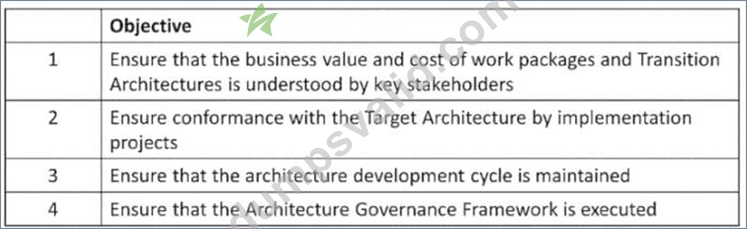
Which phase does each objective match?
- A. 1H-2F-3F-4G
- B. 1F-2G-3G-4H
- C. 1G-2H-3H-4F
- D. 1F-2G-3H-4H
Answer: A
NEW QUESTION # 205
Consider the following ADM phases objectives.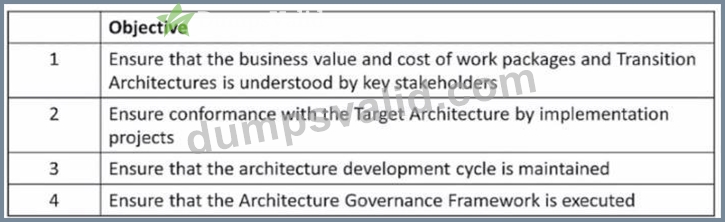
Which phase does each objective match?
- A. 1H-2F-3F-4G
- B. 1F-2G-3G-4H
- C. 1G-2H-3H-4F
- D. 1F-2G-3H-4H
Answer: A
NEW QUESTION # 206
Complete the sentence. According to TOGAF, the simplest way of thinking about the Enterprise Continuum is as a _____
- A. library of architecture artifacts
- B. Configuration Database
- C. view of the Architecture Repository
- D. Standards Information Base
- E. Requirements Management System
Answer: C
Explanation:
Section: Part 2
NEW QUESTION # 207
Which of the TOGAF architecture development phases is the first phase of an architecture development cycle, defines the scope for an engagement and identifies the stakeholders?
- A. Architecture Change Management
- B. Technology Architecture
- C. Architecture Vision
- D. Preliminary Phase
- E. Business Architecture
Answer: C
NEW QUESTION # 208
Which of the following best describes an approach for adapting the ADM in the situation where the business case for doing architecture is not well recognized?
- A. Completion of the Business Architecture should follow the Information Systems Architecture
- B. Tailor the ADM to reflect the relationships with, and dependencies on other management processes within the organization
- C. Tailor the ADM in conjunction with another architecture framework that has deliverables specific to the vertical sector
- D. Create an Architecture Vision and then a detailed Business Architecture
- E. Produce a "cut-down" version of the ADM suitable to the resources available
Answer: D
Explanation:
Section: Part 1
Explanation/Reference:
NEW QUESTION # 209
......
New OG0-093 Test Materials & Valid OG0-093 Test Engine: https://testprep.dumpsvalid.com/OG0-093-brain-dumps.html