

Online MB-500 Test Brain Dump Question and Test Engine
Real Microsoft MB-500 Exam Dumps with Correct 138 Questions and Answers
Exam Topics
The Microsoft MB-500 exam covers the following topics:
The first subject area is known as Plan Architecture & Solution Design that constitutes 10-15% of the whole content. The subtopics covered here are as follows: defining the major elements of Dynamics 365 Finance as well as Dynamics 365 Supply Chain Management; designing and implementing a user interface; implementing application lifecycle management. The next topic is Apply Developer Tools that makes up about 10-15% of the exam syllabus. The subdomains are the following: customizing finance and operations apps with the help of Visual Studio; managing source code & artifacts with the help of version control; implement finance & operations app framework functionality. Then there is the Design & Develop AOT Elements domain, which makes up 20-25% of the questions in the certification test. This area includes the following subdomains: creating forms; creating and extending tables; creating extended data types & enumerations; creating classes and extending AOT elements.
The fourth topic is Develop & Test Code and makes 10-15% of the exam content. It includes the following subdomains: developing X++ code as well as developing object-oriented code. The next section is Implement Reporting covers up 10% to 15% of the entire content. It comes with the following subdomains: explaining the capabilities & limitations of reporting tools within Dynamics 365 FO; creating, designing, as well as revising Dynamics Reports; designing, creating, and revising Dynamics workspace. Integrate & Manage Data Solutions (10-15%) covers the following subtopics: defining data integration scenarios; implementing data integration concepts & solutions; implementing data management. The last domain covered in the Microsoft MB-500 test is entitled Implement Security & Optimize Performance and makes up 10-15% of the whole content. It involves three subtopics, such as: implementing role-based security policies & requirements; applying fundamental performance optimization techniques; optimizing user interface performance.
The MB-500 exam is also known as the Microsoft Dynamics 365: Finance and Operations Apps Developer exam. It’s one of the two tests that lead you to earning the corresponding certificate which sounds as the Microsoft Certified: Dynamics 365: Finance and Operations Apps Developer Associate certification.
The exam includes the associated tasks that focus on executing and extending applications to satisfy business needs. So, the candidates for MB-500 exam prove their skills to provide solutions while utilizing standardized coding patterns for applications, extensible features, as well as external integrations.
The first resource that you should use is the skills outline. This official document will tell you a lot about the exam and its objectives. If you visit the Microsoft website, you will also find various learning paths. They will give you a lot of knowledge and experience with the technologies. There are several learning paths that you can choose from and they are as follows:
- Build Finance and Operations Apps
- Introduction to Developing with Finance and Operations Apps
- Connect to Finance and Operations Apps
- Extend Finance and Operations Apps
- Migrate Data and Go Live with Finance and Operations Apps
After that, you can take the instructor-led training courses, and as the name suggests, they are taught by the certified instructors. These tutors will explain every exam topic in a lot of detail and it will prove to be quite helpful. These courses will also give you a chance to interact with the trainers so that you can ask questions in case you face difficulties.
NEW QUESTION 57
You are a Dynamics 365 Finance developer. You have the following Extended Data Types (EDTs):
You plan to modify properties of the EDTs by using an extension.
You need to determine which operations can be performed.
Which operation is possible?
- A. Create an extension for AccountId and increase the field size.
- B. Create a derived EDT for AccountId and decrease the field size.
- C. Create an extension for AccountBase and increase the field size.
- D. Create an extension for AccountBase and modify the Form Help property.
Answer: C
Explanation:
You can only set the new String size to a value equal to or larger than the base EDT value.
Incorrect Answers:
B, C: You can only modify the value if the EDT does not extend from another EDT.
Reference:
https://docs.microsoft.com/en-us/dynamics365/fin-ops-core/dev-itpro/extensibility/modify-edt
NEW QUESTION 58
You need to modify the CashDisc form to meet the requirements.
Which objects should you use? To answer, select the appropriate options in the answer area.
NOTE: Each correct selection is worth one point.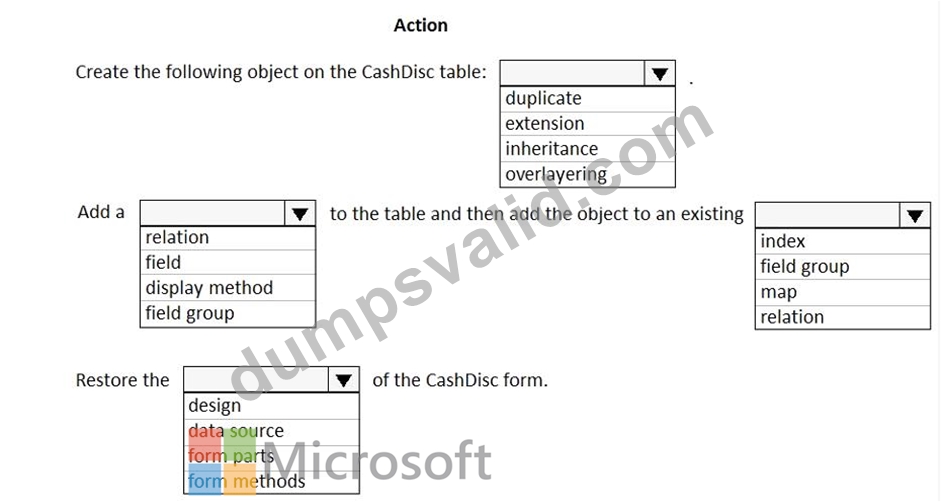
Answer:
Explanation:
Explanation:
Scenario: CashDisc form
You must extend the CashDisc form to add a new field named MinimumInvoiceAmount to the form. You must add a new Extended Data Type to the extension model for the new field. The new field must be added above the discount method field. The field must display 10 characters.
Box 1: extension
To add a new field to an existing table, you must first create a table extension.
Box 2: field
Box 3: field group
Box 4: data source
Often, the information that is stored in existing tables doesn't satisfy customer requirements. Therefore, additional tables must be created, and data from those tables must be shown on pages.
You can add new data sources to existing forms through extension. Follow these steps.
* In the extension model, create a form extension for the selected form.
* Right-click the form extension, and then select New Data Source.
Reference:
https://docs.microsoft.com/en-us/dynamics365/fin-ops-core/dev-itpro/extensibility/add-datasource
NEW QUESTION 59
You are a Dynamics 365 Finance developer.
You have a table named FMVehicle that contains a field named Vehicleld. The table has a clustered index named Vehicleldldx on the Vehicleld field. You declare a table buffer named vehicle to refer to the table.
You need to select all records from the FMVehicle table in ascending order based on Vehicleld field in the vehicle variable.
Which embedded-SQL statement should you use?
- A. select vehicle order by Vehicleididx desc;
- B. select vehicle. index Vehicleid;
- C. select vehicle order Vehicleid desc;
- D. select vehicle order by Vehicleid;
Answer: B
NEW QUESTION 60
You are a Dynamics 365 Finance developer. You are testing a workflow in a user acceptance testing environment. You need to ensure that a specific user can accept purchase requisitions only if the requisition is in a specific status. Which two options can you configure to achieve the goal? Each correct answer presents a complete solution. NOTE: Each correct selection is worth one point.
- A. automated task
- B. approval process
- C. manual decision
- D. conditional decision
- E. manual task
Answer: B,D
NEW QUESTION 61
You use the performance timer to monitor and optimize Dynamics 365 performance.
You need to view information about how many users are currently using the application.
Which performance counter should you use?
- A. Forms
- B. Services Session Provider
- C. Web Client Session
- D. GC
Answer: B
Explanation:
Reference:
https://docs.microsoft.com/en-us/dynamics365/fin-ops-core/dev-itpro/perf-test/performance-timer
NEW QUESTION 62
You need to develop, test, and deploy the Vendor Exclusion list solution.
What should you create? To answer, drag the appropriate objects to the correct actions. Each element may be used once, more than once, or not at all. You may need to drag the split bar between panes or scroll to view content.
NOTE: Each correct selection is worth one point.
Answer:
Explanation:
Explanation:
Box 1: package
An AOT package is a deployment and compilation unit of one or more models that can be applied to an environment. It includes model metadata, binaries, reports and other associated resources. One or more AOT packages can be packaged into a deployable package, which is the vehicle used for deployment of code (and customizations) on demo, sandbox, and production environments.
Box 2: New model
Model - You configure your model to refer to two other models. This enables your model to reference metadata and code elements that are in other packages.
Box 3: project
Project - You create a project and then associate your project to your new model. You add elements to your project, which are also added to your model. Specifically, you add an extended data type (EDT). You also add a table that you populate with fields and a method.
Box 4: deployable package
Reference:
https://docs.microsoft.com/en-us/dynamics365/fin-ops-core/dev-itpro/dev-tools/create-data-model-elements
NEW QUESTION 63
You are a Dynamics 365 Finance and Operations developer. You are testing a workflow in a user acceptance testing environment.
You need to ensure that a specific user can accept purchase requisitions only if the requisition is in a specific status.
Which two options can you configure to achieve the goal? Each correct answer presents a complete solution.
NOTE: Each correct selection is worth one point.
- A. automated task
- B. approval process
- C. manual decision
- D. conditional decision
- E. manual task
Answer: B,D
Explanation:
B: The approval step that you're configuring might be required only if specific conditions are met.
C: A conditional decision is a point at which a workflow divides into two branches. The system determines which branch is used by evaluating the submitted document to determine whether it meets specific conditions.
Reference:
https://docs.microsoft.com/en-sg/dynamics365/fin-ops-core/fin-ops/organization-administration/configure- conditional-decision-workflow
NEW QUESTION 64
You are a Dynamics 365 Finance developer.
You must extend the validate method of the SalesLine table by using Chain of Command. The value of a variable named SalesPrice must be greater than or equal to zero when adding new lines.
You need to create an extension class.
Which two code segments can you use? Each correct answer presents a complete solution.
NOTE: Each correct selection is worth one point.
- A.

- B.

- C.

- D.

Answer: B,D
Explanation:
Incorrect Answers:
B: Can't use = false in the 4th line.
C: Second line must be start final class, public class
Reference:
https://docs.microsoft.com/en-us/dynamics365/fin-ops-core/dev-itpro/data-entities/validations-defaults- unmapped-fields
https://docs.microsoft.com/en-us/dynamics365/fin-ops-core/dev-itpro/extensibility/method-wrapping-coc
NEW QUESTION 65
You need to implement the company's integration requirements.
Which integration strategies should you use? To answer, drag the appropriate integration strategies to the correct requirements. Each integration strategy may be used once, more than once, or not at all. You may need to drag the split bar between panes or scroll to view content.
NOTE: Each correct selection is worth one point.
Answer:
Explanation:
Explanation
Box 1: asynchronous
An asynchronous pattern is a non-blocking pattern, where the caller submits the request and then continues without waiting for a response.
Box 2: Synchronous
A synchronous pattern is a blocking request and response pattern, where the caller is blocked until the callee has finished running and gives a response.
Box 3: Synchronous
Box 4: asynchronous
Batch data is asynchronous.
Reference:
https://docs.microsoft.com/en-us/dynamics365/fin-ops-core/dev-itpro/data-entities/integration-overview#synchro
NEW QUESTION 66
You are a Dynamics 365 Finance developer.
You need configure table caching.
Which CacheLookup properties should you use? To answer, drag the CacheLookup properties to the correct table. Each property may be used once, more than once, or not at all. You may need to drag the split bar between panes or scroll to view content.
NOTE: Each correct selection is worth one point.
Answer:
Explanation: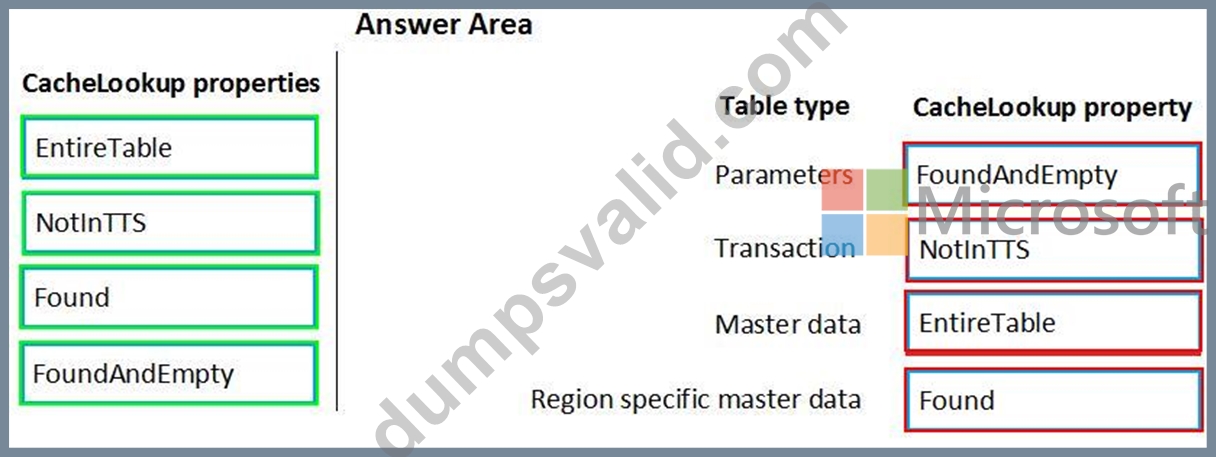
Explanation:
Box 1: FoundAndEmpty
All selects on caching keys are cached, including selects that are not returning data.
All caching key selects are returned from caching if the record exists there, or the record is marked as nonexistent in the cache. A select forUpdate in a transaction forces reading from the database and replaces the record in the cache.
An example of FoundAndEmpty record caching is in the Discount table in the Microsoft Dynamics AX standard application. By default, the Discount table has no records. By using a FoundAndEmpty cache on this table, the keys that are queried for but not found are stored in the cache. Subsequent queries for these same non-existent records can be answered from the cache without a round trip to the database.
Box 2: NotInTTS
All successful caching key selects are cached.
When in a transaction (after ttsBegin), no caches made outside the transaction are used. When inside a transaction, the record is read once from the database and subsequently from the cache. The record is select-locked when reading in a transaction, which ensures that the record cached is not updated while the transaction is active.
A typical example of the NotInTTS property is on the CustTable in the Microsoft Dynamics AX application. It is acceptable to read outdated data from the cache outside a transaction, but when data is used for validation or creating references, it is ensured that the data is real-time.
Box 3: EntireTable
Creates a set-based cache on the server. The entire table is cached as soon as at least one record is selected from the table. An EntireTable cahce is flushed whenever an insert, update or delete is made to the table. So first select read all records from DB for the selected company and all the further selects will take data from the cache instead of DB calls.
Box 4: Found
All successful caching key selects are cached. All caching key selects are returned from the cache if the record exists there. A select forUpdate in a transaction forces reading from the database and replaces the record in the cache.
This is typically used for static (lookup) tables, such as Unit, where the record usually exists.
Reference:
http://gautamax.blogspot.com/2017/01/cache-lookup-property-of-table-in-ax.html
NEW QUESTION 67
You are Dynamics 365 Finance developer.
You need to use the Extensible Data Security (XDS) framework to restrict access to the data in the Sales table from based on the customer group and the role of the user.
Which four actions should you perform in sequence? To answer, move the appropriate actions from the list of the actions to the answer area and arrange them in the correct order.
Answer:
Explanation:
1 - Define the list of constrained tables.
2 - Assign the newly created role to the user.
3 - Create new user role and add required privileges.
NEW QUESTION 68
You need to configure security for the CashDisc form.
What changes should you make? To answer, select the appropriate options in the answer area.
NOTE: Each correct selection is worth one point.
Answer:
Explanation:
NEW QUESTION 69
You are a Dynamics 365 Finance developer. You have the following Extended Data Types (EDTs):
You plan to modify the EDT properties by using an extension.
You need to determine which operations can be performed.
Which operation is possible?
- A. Create an extension for AccountId and increase the field size.
- B. Create a derived EDT for AccountId and decrease the field size.
- C. Create an extension for AccountBase and decrease the field size.
- D. Create an extension for AccountBase and increase the field size.
Answer: D
Explanation:
You can only set the new String size to a value equal to or larger than the base EDT value.
Incorrect Answers:
B, C: You can only modify the value if the EDT does not extend from another EDT.
Reference:
https://docs.microsoft.com/en-us/dynamics365/fin-ops-core/dev-itpro/extensibility/modify-edt
NEW QUESTION 70
You need to configure filtering for the Vendor Past Due Invoices form.
Which two filtering types can you use? Each correct answer presents a complete solution.
NOTE: Each correct selection is worth one point.
- A. QuickFilter
- B. Grid Column Filtering
- C. Advanced Filter
- D. Filter pane
Answer: A,B
Explanation:
A: QuickFilter: A framework-provided filtering mechanism that can appear above any list or grid, and that provides fast single-column filtering.
C: Grid column filtering: The user can define filter conditions and perform single-column sorting by using a drop dialog that is opened from the grid column header.
Scenario: You must create a batch job that runs on the last day of each month to update the current unpaid invoices with changes in the minimum invoice amount. The job must meet the following requirements:
* Allow users to specify vendors to include in the job.
* Accept the following parameters: Vendor, DueDate.
* Be callable by an Action menu item.
* Use SysOperation Framework for all batch jobs.
Reference:
https://docs.microsoft.com/en-us/dynamics365/fin-ops-core/dev-itpro/user-interface/filtering Plan Architecture and Solution Design Question Set 3
NEW QUESTION 71
You need to implement the company's integration requirements.
Which integration strategies should you use? To answer, drag the appropriate integration strategies to the correct requirements. Each integration strategy may be used once, more than once, or not at all. You may need to drag the split bar between panes or scroll to view content.
NOTE: Each correct selection is worth one point.
Answer:
Explanation:
Explanation:
Box 1: asynchronous
An asynchronous pattern is a non-blocking pattern, where the caller submits the request and then continues without waiting for a response.
Box 2: Synchronous
A synchronous pattern is a blocking request and response pattern, where the caller is blocked until the callee has finished running and gives a response.
Box 3: Synchronous
Box 4: asynchronous
Batch data is asynchronous.
Reference:
https://docs.microsoft.com/en-us/dynamics365/fin-ops-core/dev-itpro/data-entities/integration-overview#synchronous-vs-asynchronous-integration-patterns
NEW QUESTION 72
Contoso, Ltd. uses Dynamics 365 Finance. You receive reports of performance issues with the app.
You need to use Performance Timer to investigate the issues.
Which URL should you use?
- A. https://contoso.cloudax.dynamics.com/?cmp=USMF=debug=developer
- B. https://contoso.cloudax.dynamics.com/?cmp=USMF&debug=develop
- C. https://contoso.cloudax.dynamics.com/?cmp=USMF&mi=performancetimer
- D. https://contoso.cloudax.dynamics.com/?cmp=USMF&debug=perftimer
Answer: A
Explanation:
To open the Performance timer, open your webpage with the added parameter debug=develop: https:// yoursite.cloud.test.dynamics.com/en/?cmp=USMF&debug=develop Reference:
https://docs.microsoft.com/en-us/dynamics365/fin-ops-core/dev-itpro/perf-test/performance-timer
NEW QUESTION 73
You need to implement the company's integration requirements.
Which integration strategies should you use? To answer, drag the appropriate integration strategies to the correct requirements. Each integration strategy may be used once, more than once, or not at all. You may need to drag the split bar between panes or scroll to view content.
NOTE: Each correct selection is worth one point.
Answer:
Explanation: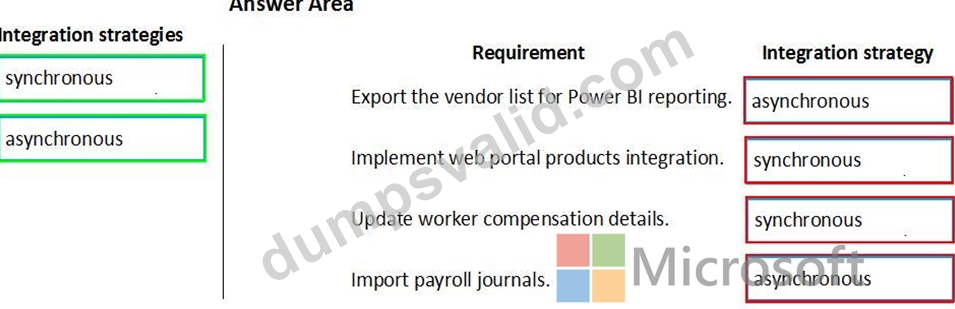
Explanation:
Box 1: asynchronous
An asynchronous pattern is a non-blocking pattern, where the caller submits the request and then continues without waiting for a response.
Box 2: Synchronous
A synchronous pattern is a blocking request and response pattern, where the caller is blocked until the callee has finished running and gives a response.
Box 3: Synchronous
Box 4: asynchronous
Batch data is asynchronous.
Reference:
https://docs.microsoft.com/en-us/dynamics365/fin-ops-core/dev-itpro/data-entities/integration-overview#synchronous-vs-asynchronous-integration-patterns
NEW QUESTION 74
You are a Dynamics 365 Finance developer for a company that sells pre-owned vehicles. When the company acquires a new vehicle, vehicle identification (VIN) numbers are added to the VIN field in the CustTable.
You need to create an event handler to validate that new VIN values are at least 10 characters long. Validation must occur when records are saved.
Which three actions should you perform in sequence? To answer, move the appropriate actions from the list of actions to the answer area and arrange them in the correct order.
Answer:
Explanation:
Explanation:
Step 1: Add the event handler method to a class.
Step 2: Copy the validateWrite event handler on the CustTable object.
validateWrite is published Table method. ValidatingWriting is the preceeding event.
Step 3: Add code to perform the validation.
Incorrect Answers:
validatingWrite is not a published Table method.
Reference:
https://docs.microsoft.com/en-us/dynamics365/fin-ops-core/dev-itpro/extensibility/customization-overlayering-extensions
NEW QUESTION 75
You add a field to the SalesTable entity by using an extension.
You need to ensure that the new field is available for use in forms, reports, and code.
What are three possible ways to achieve this goal? Each correct answer presents a complete solution.
NOTE: Each correct selection is worth one point.
- A. Navigate to the Dynamics 365 menu and select Synchronize database.
- B. Right-click the solution and select Synchronize with database.
- C. Right-click the table and select Synchronize.
- D. Set the project property for Synchronize database on build to true and build the solution.
- E. Right-click the project and select Synchronize with database.
Answer: C,D,E
NEW QUESTION 76
You need to set up a recurring integration to enable file exchanges between Dynamics 365 Finance and a third-party system.
In which order should you perform the actions? To answer, move all actions from the list of actions to the answer area and arrange them in the correct order.
Answer:
Explanation:
1. Set up a data project -
2. Create recurring data job -
3. Link a new application ID to the data recurring job -
4. Specify whether you are using a file or a data package -
5. Set up the processing recurrence
https://docs.microsoft.com/en-us/dynamics365/fin-ops-core/dev-itpro/data-entities/recurring-integrations#create-a-recurring-data-job
NEW QUESTION 77
Note: This question is part of a scries of questions that present the same scenario. Each question in the series contains a Unique solution that might meet the stated goals. Some question sets might have more than one correct solution, while others might not have a correct solution.
After you answer a question in this section, you will NOT be able to return to it. As a result, these questions will not appear in the review screen.
You create a new form in a project.
You need to display tabs in a vertical alignment.
Solution: Apply the Details Master pattern.
Does the solution meet the goal?
- A. No
- B. Yes
Answer: A
Explanation:
Explanation
https://docs.microsoft.com/en-us/dynamics365/fin-ops-core/dev-itpro/user-interface/section-tabbed-list-subpatter
NEW QUESTION 78
You need to configure security for the Vendor Exclusion List report.
What are two possible ways to achieve this goal? Each correct answer presents a complete solution.
NOTE: Each correct selection is worth one point.
- A. Create a new privilege extension and add an output menu item. Add the privilege to a duty extension and then to a role extension.
- B. Create a new privilege, add a reference to an output menu item, and then add the new privilege to a role.
- C. Create a new security policy and add an output menu item. Add the new security policy to duty extension and then to a role extension.
- D. Create a new privilege and assign it to an output menu item. Add the new privilege to a duty extension and then add the duty extension to a role.
Answer: B,D
Explanation:
Scenario: Develop necessary security permissions to view and maintain the new Vendor exclusion list functionality and reporting. Users with maintain rights will be able create, update, and delete the exclusion list. Permissions must be assigned to security roles to match company security model.
The privileges are simply a way to grant permissions to an entry point, which can be services, to a duty, role, or even directly to a user. Typically, we only add entry points to a privilege, such as menu items.
D: You can extend a Security Role or a Security Duty to add new duties/privileges to these elements.
Reference:
https://www.oreilly.com/library/view/extending-microsoft-dynamics/9781786467133/40a348f3-0f4c-4d47-a566-59f3a2e6afa0.xhtml
NEW QUESTION 79
HOTSPOT
You are a Dynamics 365 Finance developer.
You launch the Performance Timer tool to troubleshoot performance issues with a business process.
You need to view the results from the tool.
What does the tool present? To answer, select the appropriate options in the answer area.
NOTE: Each correct selection is worth one point.
Hot Area:
Answer:
Explanation:
Explanation:
Box 1: The number of open forms and ..(per second)
Forms - Forms will show how many forms are currently open, plus the rate at which they opened and closed (per second), and a set of counters, such as the total amount of created or closed forms.
Box 2: The number of open forms and ..(per second)
This should really be: Services Session provider - This is the total number of sessions created.
Reference:
https://docs.microsoft.com/en-us/dynamics365/fin-ops-core/dev-itpro/perf-test/performance-timer
NEW QUESTION 80
......
Valid MB-500 Test Answers & Microsoft MB-500 Exam PDF: https://testprep.dumpsvalid.com/MB-500-brain-dumps.html