

2025 C-ABAPD-2309 dumps review - Professional Quiz Study Materials
C-ABAPD-2309 Test Prep Training Practice Exam Questions Practice Tests
SAP C-ABAPD-2309 Exam Syllabus Topics:
| Topic | Details |
|---|---|
| Topic 1 |
|
| Topic 2 |
|
| Topic 3 |
|
NEW QUESTION # 23
You have a superclass superl and a subclass subl of superl. Each class has an instance constructor and a static constructor. The first statement of your program creates an instance of subl. In which sequence will the constructors be executed?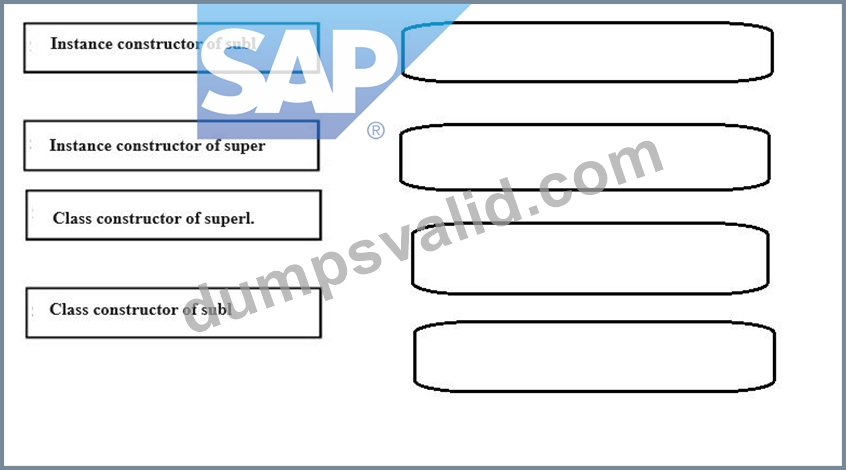
Answer:
Explanation: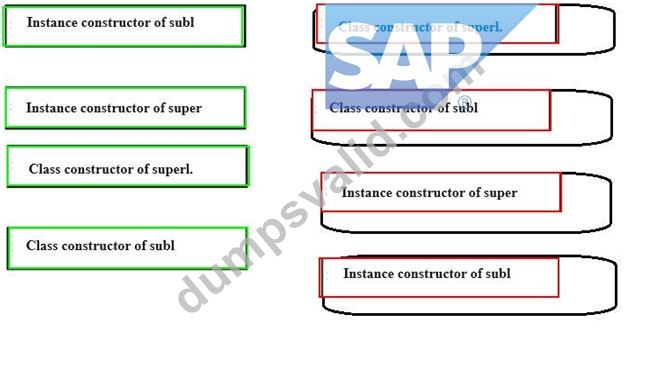
NEW QUESTION # 24
Image:
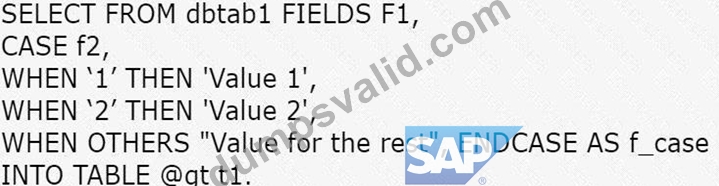
In the following ABAP SQL code, what are valid case distinctions? Note: There are 2 correct answers to this question.
- A.

- B.

- C.

- D.
Answer: B,C
NEW QUESTION # 25
What is the sequence priority when evaluating a logical expression?
- A. B A C
- B. OR 3
- C. NOT 1
- D. AND 2
- E. A B C
- F. A C B
- G. CAB
Answer: D
Explanation:
The sequence priority when evaluating a logical expression is C. A C B, which means NOT, AND, OR. This is the order of precedence of the Boolean operators in ABAP, which determines how the system implicitly parenthesizes all logical expressions that are not closed by explicit parentheses. The operator with the highest priority is evaluated first, and the operator with the lowest priority is evaluated last. The order of precedence of the Boolean operators in ABAP is as follows12:
* NOT: The NOT operator is a unary operator that negates the logical expression that follows it. It has the highest priority and is evaluated before any other operator. For example, in the expression NOT a AND b, the NOT operator is applied to a first, and then the AND operator is applied to the result and b.
* AND: The AND operator is a binary operator that returns true if both logical expressions on its left and right are true, and false otherwise. It has the second highest priority and is evaluated before the OR and EQUIV operators. For example, in the expression a AND b OR c, the AND operator is applied to a and b first, and then the OR operator is applied to the result and c.
* OR: The OR operator is a binary operator that returns true if either or both logical expressions on its left and right are true, and false otherwise. It has the third highest priority and is evaluated after the NOT and AND operators, but before the EQUIV operator. For example, in the expression a OR b EQUIV c, the OR operator is applied to a and b first, and then the EQUIV operator is applied to the result and c.
* EQUIV: The EQUIV operator is a binary operator that returns true if both logical expressions on its left and right have the same truth value, and false otherwise. It has the lowest priority and is evaluated after all other operators. For example, in the expression a AND b EQUIV c OR d, the EQUIV operator is applied to a AND b and c last, after the AND and OR operators are applied.
References: 1: log_exp - Boolean Operators and Parentheses - ABAP Keyword Documentation - SAP Online Help 2: Logical Expressions (log_exp) - ABAP Keyword Documentation - SAP Online Help
NEW QUESTION # 26
Which extensibility type does SAP recommend you use to enhance the existing UI for an SAP Fiori app?
- A. Developer
- B. Side-by-side
- C. Key user
- D. Classic
Answer: A
Explanation:
Explanation
According to the SAP clean core extensibility and ABAP cloud topic, SAP recommends using developer extensibility to enhance the existing UI for an SAP Fiori app. Developer extensibility allows you to use the UI adaptation editor in SAP Web IDE to modify the UI layout, add or remove fields, and bind them to the data model. You can also use the SAPUI5 framework to create custom controls, views, and controllers. Developer extensibility is based on the in-app extensibility concept, which means that the extensions are part of the same application and are deployed together with the app. Developer extensibility requires developer skills and access to the source code of the app. References: SAP Learning Hub, SAP S/4HANA Cloud Extensibility - In-App Extensibility, SAP Fiori: Extensibility
NEW QUESTION # 27
Which RESTful Application Programming object can be used to organize the display of fields in an app?
- A. Projection view
- B. Service definition
- C. Data model view
- D. Metadata extension
Answer: D
Explanation:
A metadata extension is a RESTful Application Programming object that can be used to organize the display of fields in an app. A metadata extension is a CDS view that annotates another CDS view with UI annotations, such as labels, icons, or facets. These annotations define how the data should be presented in the app, such as which fields should be shown on the object page, which fields should be editable, or which fields should be used for filtering or sorting. A metadata extension can also be used to add custom actions or validations to the app12. Reference: 1: Refine the Object Page with Annotations | SAP Tutorials 2: ABAP RAP : Enabling custom actions with a dialog for additional input fields | SAP Blogs
NEW QUESTION # 28 
with which predicate condition can you ensure that the CAST will work?
- A. IS NOT INITIAL
- B. IS SUPPLIED
- C. IS INSTANCE OF
- D. IS BOUND
Answer: C
Explanation:
The predicate condition that can be used to ensure that the CAST will work is IS INSTANCE OF. The IS INSTANCE OF predicate condition checks whether the operand is an instance of the specified class or interface. This is useful when you want to perform a downcast, which is a conversion from a more general type to a more specific type. A downcast can fail if the operand is not an instance of the target type, and this can cause a runtime error. Therefore, you can use the IS INSTANCE OF predicate condition to check whether the downcast is possible before using the CAST operator12. For example:
* The following code snippet uses the IS INSTANCE OF predicate condition to check whether the variable g_super is an instance of the class lcl_super. If it is, the CAST will work and the variable g_sub1 will be assigned the value of g_super.
DATA: g_super TYPE REF TO lcl_super, g_sub1 TYPE REF TO lcl_sub1. IF g_super IS INSTANCE OF lcl_super. g_sub1 = CAST #( g_super ). g_sub1->method( ... ). ENDIF.
You cannot do any of the following:
* IS SUPPLIED: The IS SUPPLIED predicate condition checks whether an optional parameter of a method or a function module has been supplied by the caller. This is useful when you want to handle different cases depending on whether the parameter has a value or not. However, this predicate condition has nothing to do with the CAST operator or the type of the operand12.
* IS NOT INITIAL: The IS NOT INITIAL predicate condition checks whether the operand has a non- initial value. This is useful when you want to check whether the operand has been assigned a value or not. However, this predicate condition does not guarantee that the CAST will work, because the operand may have a value but not be an instance of the target type12.
* IS BOUND: The IS BOUND predicate condition checks whether the operand is a bound reference variable. This is useful when you want to check whether the operand points to an existing object or not. However, this predicate condition does not guarantee that the CAST will work, because the operand may point to an object but not be an instance of the target type12.
References: 1: Predicate Expressions - ABAP Keyword Documentation - SAP Online Help 2: ABAP - Predicates | SAP Community
NEW QUESTION # 29
In an Access Control Object, which clauses are used? Note: There are 3 correct answers to this question.
- A. Where (to specify the access conditions)
- B. Revoke (to remove access to the data source)
- C. Define role (to specify the role name)
- D. Crant (to identify the data source)
- E. Return code (to assign the return code of the authority check)
Answer: A,B,C
Explanation:
An Access Control Object (ACO) is a CDS annotation that defines the access control rules for a CDS view entity. An ACO consists of one or more clauses that specify the role name, the data source, the access conditions, and the return code of the authority check12. Some of the clauses that are used in an ACO are:
Where (to specify the access conditions): This clause is used to define the logical expression that determines whether a user has access to the data source or not. The expression can use the fields of the data source, the parameters of the CDS view entity, or the predefined variables $user and $session. The expression can also use the functions check_authorization and check_role to perform additional authority checks12.
Define role (to specify the role name): This clause is used to assign a name to the role that is defined by the ACO. The role name must be unique within the namespace of the CDS view entity and must not contain any special characters. The role name can be used to reference the ACO in other annotations, such as @AccessControl.authorizationCheck or @AccessControl.grant12.
Revoke (to remove access to the data source): This clause is used to explicitly deny access to the data source for a user who meets the conditions of the where clause. The revoke clause overrides any grant clause that might grant access to the same user. The revoke clause can be used to implement the principle of least privilege or to enforce data segregation12.
You cannot do any of the following:
Grant (to identify the data source): This is not a valid clause in an ACO. The grant clause is a separate annotation that is used to grant access to a CDS view entity or a data source for a user who has a specific role. The grant clause can reference an ACO by its role name to apply the access conditions defined by the ACO12.
Return code (to assign the return code of the authority check): This is not a valid clause in an ACO. The return code of the authority check is a predefined variable that is set by the system after performing the access control check. The return code can be used in the where clause of the ACO to specify different access conditions based on the outcome of the check12.
NEW QUESTION # 30
Which patterns raise an exception? Note: There are 3 correct answers to this question.
- A. DATA: gv_target TYPE p DECIMALS 2. CONSTANTS: go intl TYPE i VALUE 3. gv_target -U EXACT (2 gcojntl).
- B. DATA: gv_target TYPE string. □ CONSTANTS: gco_string TYPE LENGTH 16 VALUE 0123456789ABCDEF*. gv_target = EXACT # gco_string+5 (5) ).
- C. DATA: Ev target TYPE p DECIMALS 3. CONSTANTS: gcojntl TYPE i VALUE 2. Ev_target -U EXACT #2 / gcojntl ).
- D. DATA: gv_target TYPE d. s/ □ CONSTANTS: gco_date TYPE d VALUE '20331233*. gv_target EXACT ( geo_date).
- E. DATA: gv_target TYPE c LENGTH 5. V □ CONSTANTS: ECO string TYPE string VALUE 0123456789ABCDEF". gv_target - EXACT (gco_string + 5 (6) ).
Answer: A,D,E
Explanation:
The patterns that raise an exception are those that use the constructor operator EXACT to perform a lossless assignment or calculation, but the result cannot be converted to the target data type without data loss. The following are the explanations for each pattern:
A: This pattern raises the exception CX_SY_CONVERSION_LOST because the result of the calculation 2 * 3 is 6, which cannot be assigned to a packed number with two decimal places without losing the integer part. The operator -U is used to perform a lossless calculation with the calculation type decfloat34.
B: This pattern does not raise an exception because the result of the substring expression gco_string+5(5) is '6789A', which can be assigned to a string without data loss. The operator EXACT # is used to perform a lossless assignment with the data type of the argument.
C: This pattern raises the exception CX_SY_CONVERSION_LOST because the result of the substring expression gco_string+5(6) is '6789AB', which cannot be assigned to a character field with length 5 without losing the last character. The operator EXACT is used to perform a lossless assignment with the data type of the target field.
D: This pattern does not raise an exception because the result of the calculation 2 / 2 is 1, which can be assigned to a packed number with three decimal places without data loss. The operator -U is used to perform a lossless calculation with the calculation type decfloat34.
E: This pattern raises the exception CX_SY_CONVERSION_ERROR because the constant gco_date contains an invalid value '20331233' for a date data type, which cannot be converted to a valid date. The operator EXACT is used to perform a lossless assignment with the data type of the target field.
NEW QUESTION # 31
In ABAP SQL, which of the following can be assigned an alias? Note: There are 2 correct answers to this question.
- A. order criterion (from order by clause)
- B. field (from field list)
- C. group criterion (from group by clause)
- D. database table
Answer: B,D
Explanation:
In ABAP SQL, an alias is a temporary name that can be assigned to a field or a database table in a query. An alias can be used to make the query more readable, to avoid name conflicts, or to access fields or tables with long names. An alias is created with the AS keyword and is only valid for the duration of the query1.
The following are examples of how to assign an alias to a field or a database table in ABAP SQL:
* B. field (from field list): A field is a column of a table or a view that contains data of a certain type. A field can be assigned an alias in the field list of a SELECT statement, which specifies the fields that are selected from the data source. For example, the following query assigns the alias name to the field carrname of the table scarr:
SELECT carrid, carrname AS name FROM scarr.
The alias name can be used instead of carrname in other clauses of the query, such as WHERE, GROUP BY, ORDER BY, and so on2.
* C. database table: A database table is a collection of data that is organized in rows and columns. A database table can be assigned an alias in the FROM clause of a SELECT statement, which specifies the data source that is selected from. For example, the following query assigns the alias c to the table scarr:
SELECT c.carrid, c.carrname FROM scarr AS c.
The alias c can be used instead of scarr in other clauses of the query, such as WHERE, JOIN, GROUP BY, ORDER BY, and so on3.
The following are not valid for assigning an alias in ABAP SQL:
* A. order criterion (from order by clause): An order criterion is a field or an expression that is used to sort the result set of a query in ascending or descending order. An order criterion cannot be assigned an alias in the ORDER BY clause of a SELECT statement, because the alias is not visible in this clause. The alias can only be used in the clauses that follow the clause where it is defined1.
* D. group criterion (from group by clause): A group criterion is a field or an expression that is used to group the result set of a query into subsets that share the same values. A group criterion cannot be assigned an alias in the GROUP BY clause of a SELECT statement, because the alias is not visible in this clause. The alias can only be used in the clauses that follow the clause where it is defined1.
References: 1: ALIASES - ABAP Keyword Documentation 2: SELECT List - ABAP Keyword Documentation 3: FROM Clause - ABAP Keyword Documentation
NEW QUESTION # 32
In what order are objects created to generate a RESTful Application Programming application?
A) Database table 1
B) Service binding Projection view 4
C) Service definition 3
D) Data model view 2
- A. B D C A
- B. A D C B
- C. D A B C
- D. C B A B
Answer: B
Explanation:
The order in which objects are created to generate a RESTful Application Programming application is A, D, C, B. This means that the following steps are followed:
First, a database table is created to store the data for the application. A database table is a CDS DDIC-based view that defines a join or union of database tables. A database table has an SQL view attached and can be accessed by Open SQL or native SQL.
Second, a data model view is created to define a data model based on the database table or other CDS view entities. A data model view is a CDS view entity that can have associations, aggregations, filters, parameters, and annotations. A data model view can also define the behavior definition and implementation for the business object.
Third, a service definition is created to define the service interface for the application. A service definition is a CDS view entity that defines a projection on a data model view or another service definition. A service definition can also define service metadata, such as service name, version, description, and annotations.
Fourth, a service binding is created to define the service binding for the application. A service binding is a CDS view entity that defines a projection on a service definition. A service binding can also define the service protocol, such as OData V2, OData V4, or REST, and the service URL.
NEW QUESTION # 33 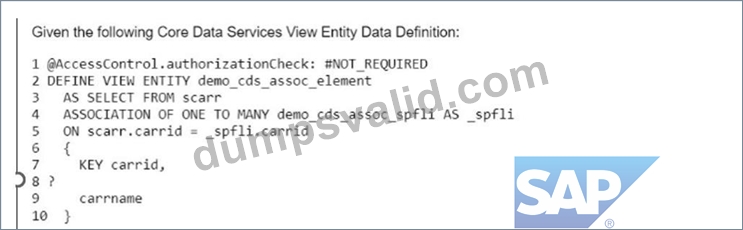
The "demo_ods_assoc_spfi data source referenced in line #4 contains a field "connid" which you would like to expose in the element list.
Which of the following statements would do this if inserted on line #8?
- A. spfli-connid,
- B. demo_ods_assoc_spfli-connid/
- C. demo_ods_assoc_spfli.connid,
- D. _spfli.connid/
Answer: C
Explanation:
Explanation
The statement that can be used to expose the field "connid" of the data source "demo_ods_assoc_spfli" in the element list is A. demo_ods_assoc_spfli.connid,.
This statement uses the dot notation to access the field "connid" of the data source "demo_ods_assoc_spfli", which is an association defined on line #4. The association "demo_ods_assoc_spfli" links the data source "demo_ods" with the table "spfli" using the field "carrid".
The statement also ends with a comma to separate it from the next element in the list12.
You cannot do any of the following:
B). demo_ods_assoc_spfli-connid/: This statement uses the wrong syntax to access the field "connid" of the data source "demo_ods_assoc_spfli". The dash notation is used to access the components of a structure or a table, not the fields of a data source. The statement also ends with a slash, which is not a valid separator for the element list12.
C). spfli-connid,: This statement uses the wrong data source name to access the field "connid". The data source name should be "demo_ods_assoc_spfli", not "spfli". The statement also uses the wrong syntax to access the field "connid", as explained above12.
D). _spfli.connid/: This statement uses the wrong data source name and the wrong separator to access the field "connid". The data source name should be "demo_ods_assoc_spfli", not "_spfli". The statement also ends with a slash, which is not a valid separator for the element list12.
References: 1: ABAP CDS - SELECT, select_list - ABAP Keyword Documentation - SAP Online Help 2: ABAP CDS - SELECT, from - ABAP Keyword Documentation - SAP Online Help
NEW QUESTION # 34 
The "demo_ods_assoc_spfi data source referenced in line #4 contains a field "connid" which you would like to expose in the element list.
Which of the following statements would do this if inserted on line #8?
- A. spfli-connid,
- B. demo_ods_assoc_spfli-connid/
- C. demo_ods_assoc_spfli.connid,
- D. _spfli.connid/
Answer: C
Explanation:
The statement that can be used to expose the field "connid" of the data source "demo_ods_assoc_spfli" in the element list is A. demo_ods_assoc_spfli.connid,. This statement uses the dot notation to access the field
"connid" of the data source "demo_ods_assoc_spfli", which is an association defined on line #4. The association "demo_ods_assoc_spfli" links the data source "demo_ods" with the table "spfli" using the field
"carrid". The statement also ends with a comma to separate it from the next element in the list12.
You cannot do any of the following:
* B. demo_ods_assoc_spfli-connid/: This statement uses the wrong syntax to access the field "connid" of the data source "demo_ods_assoc_spfli". The dash notation is used to access the components of a structure or a table, not the fields of a data source. The statement also ends with a slash, which is not a valid separator for the element list12.
* C. spfli-connid,: This statement uses the wrong data source name to access the field "connid". The data source name should be "demo_ods_assoc_spfli", not "spfli". The statement also uses the wrong syntax to access the field "connid", as explained above12.
* D. _spfli.connid/: This statement uses the wrong data source name and the wrong separator to access the field "connid". The data source name should be "demo_ods_assoc_spfli", not "_spfli". The statement also ends with a slash, which is not a valid separator for the element list12.
References: 1: ABAP CDS - SELECT, select_list - ABAP Keyword Documentation - SAP Online Help 2: ABAP CDS - SELECT, from - ABAP Keyword Documentation - SAP Online Help
NEW QUESTION # 35
In a test method you call method cl_abap_unit_assert=>assert_equals( .. ) in the following way:
CLASS Itcl1 DEFINITION FOR TESTING RISK LEVEL HARMLESS DURATION SHORT.
PRIVATE SECTION.
METHODS m1 FOR TESTING.
ENDCLASS.
CLASS Itcl1 IMPLEMENTATION.
METHOD m1.
DATA: go_test_object TYPE REF TO zcl_to_be_tested.
CONSTANTS: Ico_exp TYPE string VALUE 'test2'.
CREATE OBJECT go_test_object.
cl_abap_unit_assert=>assert_equals(
EXPORTING
act = go_class->mv_attribute
exp = lco_exp
msg = 'assert equals failed ' && go_test_object->mv_attribute && ' ' && lco_exp ENDMETHOD.
ENDCLASS.
What will happen if method parameters act and exp are not equal?
- A. There will be a message in the test log.
- B. The tested unit cannot be transported.
- C. The tested unit will automatically be appended to a default ABAP Test Cockpit Variant.
- D. The test will be aborted.
Answer: A
NEW QUESTION # 36
Which patterns raise an exception? Note: There are 3 correct answers to this question.
- A. DATA: gv_target TYPE c LENGTH 5. V CONSTANTS: ECO string TYPE string VALUE
0123456789ABCDEF". gv_target - EXACT (gco_string + 5 (6) ). - B. DATA: gv_target TYPE p DECIMALS 2. CONSTANTS: go intl TYPE i VALUE 3. gv_target -U EXACT (2 gcojntl).
- C. DATA: gv_target TYPE string. CONSTANTS: gco_string TYPE LENGTH 16 VALUE
0123456789ABCDEF*. gv_target = EXACT # gco_string+5 (5) ). - D. DATA: gv_target TYPE d. s/ CONSTANTS: gco_date TYPE d VALUE '20331233*. gv_target EXACT ( geo_date).
- E. DATA: Ev target TYPE p DECIMALS 3. CONSTANTS: gcojntl TYPE i VALUE 2. Ev_target -U EXACT #2 / gcojntl ).
Answer: A,B,D
Explanation:
Explanation
The patterns that raise an exception are those that use the constructor operator EXACT to perform a lossless assignment or calculation, but the result cannot be converted to the target data type without data loss. The following are the explanations for each pattern:
A: This pattern raises the exception CX_SY_CONVERSION_LOST because the result of the calculation 2 * 3 is 6, which cannot be assigned to a packed number with two decimal places without losing the integer part. The operator -U is used to perform a lossless calculation with the calculation type decfloat34.
B: This pattern does not raise an exception because the result of the substring expression gco_string+5(5) is '6789A', which can be assigned to a string without data loss. The operator EXACT # is used to perform a lossless assignment with the data type of the argument.
C: This pattern raises the exception CX_SY_CONVERSION_LOST because the result of the substring expression gco_string+5(6) is '6789AB', which cannot be assigned to a character field with length 5 without losing the last character. The operator EXACT is used to perform a lossless assignment with the data type of the target field.
D: This pattern does not raise an exception because the result of the calculation 2 / 2 is 1, which can be assigned to a packed number with three decimal places without data loss. The operator -U is used to perform a lossless calculation with the calculation type decfloat34.
E: This pattern raises the exception CX_SY_CONVERSION_ERROR because the constant gco_date contains an invalid value '20331233' for a date data type, which cannot be converted to a valid date.
The operator EXACT is used to perform a lossless assignment with the data type of the target field.
References: EXACT - Lossless Operator - ABAP Keyword Documentation, Lossless Assignments - ABAP Keyword Documentation
NEW QUESTION # 37
Exhibit:
With Icl_super being superclass for Icl_subl and Icl_sub2 and with methods subl_methl and sub2_methl being subclass-specific methods of Id_subl or Icl_sub2, respectivel. What will happen when executing these casts?
Note:
There are 2 correct answers to this question
- A. go_subl->subl_meth !(...)* w'll work.
- B. go_sub2 = CAST # go super), will work. go_subl CAST #go_super), will work
- C. go_sub2 = CAST #(go_super). will not work. ] go sub2->sub2 meth 1(...). will work
- D. go subl = CAST # go super), will not work
Answer: A,D
Explanation:
The following are the explanations for each statement:
* A: This statement is correct. go_subl = CAST #(go_super) will not work. This is because go_subl is a data object of type REF TO cl_subl, which is a reference to the subclass cl_subl. go_super is a data object of type REF TO cl_super, which is a reference to the superclass cl_super. The CAST operator is used to perform a downcast or an upcast of a reference variable to another reference variable of a compatible type. A downcast is a conversion from a more general type to a more specific type, while an upcast is a conversion from a more specific type to a more general type. In this case, the CAST operator is trying to perform a downcast from go_super to go_subl, but this is not possible, as go_super is not pointing to an instance of cl_subl, but to an instance of cl_super. Therefore, the CAST operator will raise an exception CX_SY_MOVE_CAST_ERROR at runtime12
* B: This statement is incorrect. go_sub2 = CAST #(go_super) will work. go_subl = CAST #(go_super) will not work. This is because go_sub2 is a data object of type REF TO cl_sub2, which is a reference to the subclass cl_sub2. go_super is a data object of type REF TO cl_super, which is a reference to the superclass cl_super. The CAST operator is used to perform a downcast or an upcast of a reference variable to another reference variable of a compatible type. A downcast is a conversion from a more general type to a more specific type, while an upcast is a conversion from a more specific type to a more general type. In this case, the CAST operator is trying to perform a downcast from go_super to go_sub2, and this is possible, as go_super is pointing to an instance of cl_sub2, which is a subclass of cl_super.
* Therefore, the CAST operator will assign the reference of go_super to go_sub2 without raising an exception. However, the CAST operator will not work for go_subl, as explained in statement A12
* C: This statement is incorrect. go_sub2 = CAST #(go_super) will work. go_sub2->sub2_meth1(...) will not work. This is because go_sub2 is a data object of type REF TO cl_sub2, which is a reference to the subclass cl_sub2. go_super is a data object of type REF TO cl_super, which is a reference to the superclass cl_super. The CAST operator is used to perform a downcast or an upcast of a reference variable to another reference variable of a compatible type. A downcast is a conversion from a more general type to a more specific type, while an upcast is a conversion from a more specific type to a more general type. In this case, the CAST operator is trying to perform a downcast from go_super to go_sub2, and this is possible, as go_super is pointing to an instance of cl_sub2, which is a subclass of cl_super.
Therefore, the CAST operator will assign the reference of go_super to go_sub2 without raising an exception. However, the method call go_sub2->sub2_meth1(...) will not work, as sub2_meth1 is a subclass-specific method of cl_sub2, which is not inherited by cl_super. Therefore, the method call will raise an exception CX_SY_DYN_CALL_ILLEGAL_METHOD at runtime123
* D: This statement is correct. go_subl->subl_meth1(...) will work. This is because go_subl is a data object of type REF TO cl_subl, which is a reference to the subclass cl_subl. subl_meth1 is a subclass-specific method of cl_subl, which is not inherited by cl_super. Therefore, the method call go_subl->subl_meth1(...) will work, as go_subl is pointing to an instance of cl_subl, which has the method subl_meth1123 References: NEW - ABAP Keyword Documentation, CAST - ABAP Keyword Documentation, Method Call - ABAP Keyword Documentation
NEW QUESTION # 38
In RESTful Application Programming, which EML statement retrieves an object?
- A. Read entity
- B. Get entity
- C. Find entity
- D. Select entity
Answer: B
Explanation:
Explanation
In RESTful Application Programming, the EML statement that retrieves an object is GET entity. The GET entity statement is used to read data of an entity instance from the database or the transaction buffer. The GET entity statement can specify the entity name, the entity key, and the entity elements to be retrieved. The GET entity statement can also use the IN LOCAL MODE addition to bypass the access control, authorization control, and feature control checks. The GET entity statement returns a single entity instance or raises an exception if no instance is found or multiple instances match the key.
The other EML statements are not used to retrieve an object, but have different purposes and effects. These statements are:
FIND entity: This statement is used to search for entity instances that match a given condition. The FIND entity statement can specify the entity name, the entity elements to be returned, and the condition to be applied. The FIND entity statement can also use the IN LOCAL MODE addition to bypass the access control, authorization control, and feature control checks. The FIND entity statement returns a table of entity instances or an empty table if no instances match the condition.
SELECT entity: This statement is used to query data of entity instances from the database or the transaction buffer. The SELECT entity statement can specify the entity name, the entity elements to be returned, and the filter, order, and aggregation options to be applied. The SELECT entity statement can also use the IN LOCAL MODE addition to bypass the access control, authorization control, and feature control checks. The SELECT entity statement returns a table of entity instances or an empty table if no instances match the query.
READ entity: This statement is not a valid EML statement, but an ABAP statement. The READ statement is used to access a single row of an internal table using the table index or the table key. The READ statement can also use the TRANSPORTING addition to specify which fields should be returned, and the INTO addition to specify the target variable. The READ statement returns a single row of the internal table or raises an exception if no row is found or multiple rows match the key.
References: GET ENTITY - ABAP Keyword Documentation, FIND ENTITY, ENTITIES - ABAP Keyword Documentation, SELECT ENTITY, ENTITIES - ABAP Keyword Documentation, READ - ABAP Keyword Documentation
NEW QUESTION # 39
What RESTful Application Programming object contains only the fields required for a particular app?
- A. Projection View
- B. Database view
- C. Data model view
- D. Metadata extension
Answer: A
Explanation:
A projection view is a RESTful Application Programming object that contains only the fields required for a particular app. A projection view is a CDS view entity that defines a projection on an existing CDS view entity or CDS DDIC-based view. A projection view exposes a subset of the elements of the projected entity, which are relevant for a specific business service. A projection view can also define aliases, virtual elements, and annotations for the projected elements. A projection view is the top-most layer of a CDS data model and prepares data for a particular use case. A projection view can have different provider contracts depending on the type of service it supports, such as transactional query, analytical query, or transactional interface.
A database view is a CDS DDIC-based view that defines a join or union of database tables. A database view has an SQL view attached and can be accessed by Open SQL or native SQL. A database view can be used as a projected entity for a projection view, but it does not contain only the fields required for a particular app.
A metadata extension is a RESTful Application Programming object that defines additional annotations for a CDS view entity or a projection view. A metadata extension can be used to enhance the metadata of a CDS data model without changing the original definition. A metadata extension does not contain any fields, but only annotations.
A data model view is a CDS view entity that defines a data model based on database tables or other CDS view entities. A data model view can have associations, aggregations, filters, parameters, and annotations. A data model view can be used as a projected entity for a projection view, but it does not contain only the fields required for a particular app.
References: CDS Projection Views - ABAP Keyword Documentation, CDS Projection Views in ABAP CDS:
What's Your Flavor, Business Object Projection - ABAP Keyword Documentation
NEW QUESTION # 40
Given the following code,
DATA gv_text1 TYPE string. "#EC_NEEDED
DATA gv_text2 TYPE string ##NEEDED.
What are valid statements? Note: There are 2 correct answers to this question.
- A. The pragma is not checked by the syntax checker.
- B. The pseudo-comment is checked by the syntax checker
- C. #EC_NEEDED is not checked by the syntax checker.
- D. ##NEEDED is checked by the syntax checker.
Answer: A,D
Explanation:
Both statements are valid in ABAP, but they have different effects on the program.
* ##NEEDED is a pragma that can be used to hide warnings from the ABAP compiler syntax check. It tells the check tools that a variable or a parameter is needed for further processing, even if it is not used in the current statement. For example, if you declare a variable without assigning any value to it, you can use ##NEEDED to suppress the warning about unused variables12.
* The pragma is not checked by the syntax checker means that you can use any pragma to hide any warning from the ABAP compiler syntax check, regardless of its effect on the program logic or performance. For example, if you use ##SHADOW to hide a warning about an obscured function, you can also use it to hide a warning about an invalid character in a string12.
You cannot do any of the following:
* #EC_NEEDED is not checked by the syntax checker: This is not a valid statement in ABAP. There is no pseudo-comment with #EC_NEEDED in ABAP3.
* The pseudo-comment is checked by the syntax checker: This is false. Pseudo-comments are obsolete and should no longer be used in ABAP. They were replaced by pragmas since SAP NW 7.0 EhP2 (Enhancement Package)4.
References: 1: Pragmas - ABAP Keyword Documentation - SAP Online Help 2: [What are pragmas and pseudo comments in ABAP? | SAP Blogs - SAP Community] 3: ABAP Keyword Documentation - SAP Online Help 4: What are PRAGMAS and Pseudo comments in SAP ABAP
NEW QUESTION # 41
You have a superclass superl and a subclass subl of superl. Each class has an instance constructor and a static constructor. The first statement of your program creates an instance of subl. In which sequence will the constructors be executed?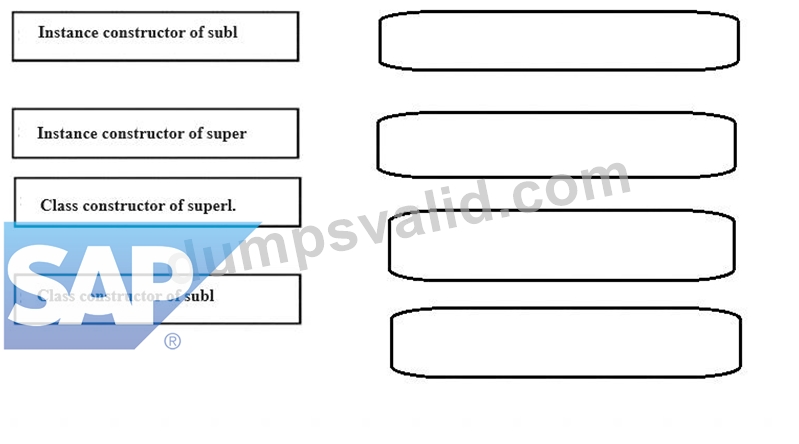
Answer:
Explanation: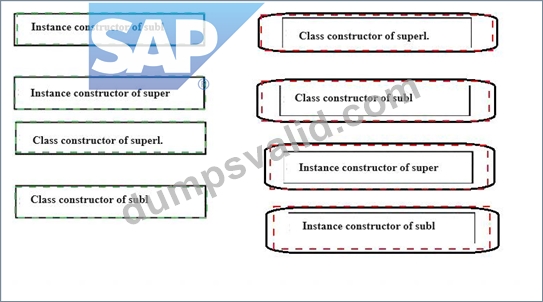
Explanation:
The sequence in which the constructors will be executed is as follows:
* Class constructor of superl. This is because the class constructor is a static method that is executed automatically before the class is accessed for the first time. The class constructor is used to initialize the static attributes and components of the class. The class constructor of the superclass is executed before the class constructor of the subclass, as the subclass inherits the static components of the superclass12
* Class constructor of subl. This is because the class constructor is a static method that is executed automatically before the class is accessed for the first time. The class constructor is used to initialize the static attributes and components of the class. The class constructor of the subclass is executed after the class constructor of the superclass, as the subclass inherits the static components of the superclass12
* Instance constructor of superl. This is because the instance constructor is an instance method that is executed automatically when an instance of the class is created using the statement CREATE OBJECT.
The instance constructor is used to initialize the instance attributes and components of the class. The instance constructor of the superclass is executed before the instance constructor of the subclass, as the subclass inherits the instance components of the superclass. The instance constructor of the subclass must call the instance constructor of the superclass explicitly using super->constructor, unless the superclass is the root node object12
* Instance constructor of subl. This is because the instance constructor is an instance method that is executed automatically when an instance of the class is created using the statement CREATE OBJECT.
The instance constructor is used to initialize the instance attributes and components of the class. The instance constructor of the subclass is executed after the instance constructor of the superclass, as the subclass inherits the instance components of the superclass. The instance constructor of the subclass must call the instance constructor of the superclass explicitly using super->constructor, unless the superclass is the root node object12 References: Constructors of Classes - ABAP Keyword Documentation, METHODS - constructor - ABAP Keyword Documentation
NEW QUESTION # 42
Image:
In the following ABAP SQL code, what are valid case distinctions? Note: There are 2 correct answers to this question.
A)
B)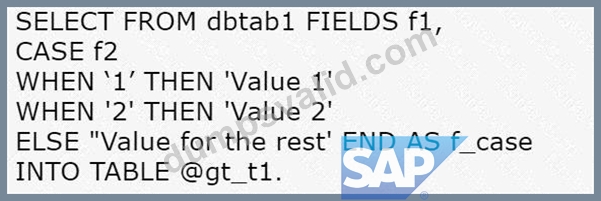
C)
D)
- A. Option D
- B. Option B
- C. Option A
- D. Option C
Answer: B,C
NEW QUESTION # 43
You have a superclass superl and a subclass subl of superl. Each class has an instance constructor and a static constructor. The first statement of your program creates an instance of subl. In which sequence will the constructors be executed?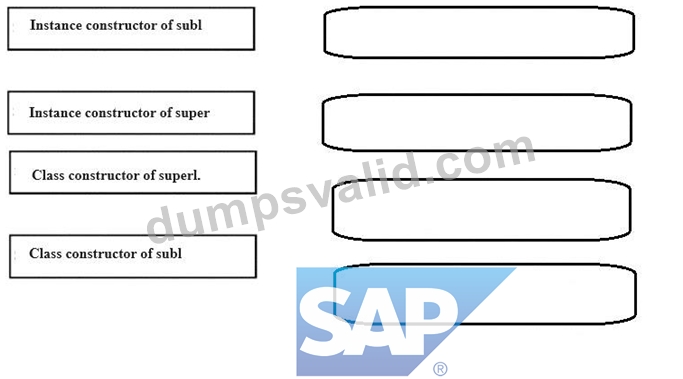
Answer:
Explanation: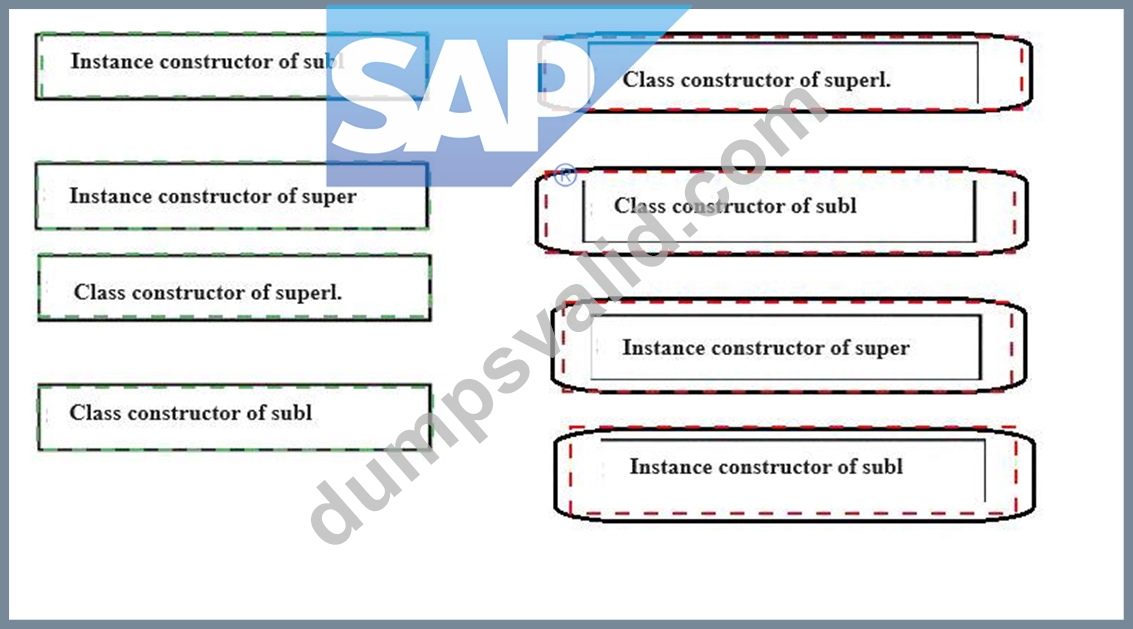
Explanation:
The sequence in which the constructors will be executed is as follows:
* Class constructor of superl. This is because the class constructor is a static method that is executed automatically before the class is accessed for the first time. The class constructor is used to initialize the static attributes and components of the class. The class constructor of the superclass is executed before the class constructor of the subclass, as the subclass inherits the static components of the superclass12
* Class constructor of subl. This is because the class constructor is a static method that is executed automatically before the class is accessed for the first time. The class constructor is used to initialize the static attributes and components of the class. The class constructor of the subclass is executed after the class constructor of the superclass, as the subclass inherits the static components of the superclass12
* Instance constructor of superl. This is because the instance constructor is an instance method that is executed automatically when an instance of the class is created using the statement CREATE OBJECT.
The instance constructor is used to initialize the instance attributes and components of the class. The instance constructor of the superclass is executed before the instance constructor of the subclass, as the subclass inherits the instance components of the superclass. The instance constructor of the subclass must call the instance constructor of the superclass explicitly using super->constructor, unless the superclass is the root node object12
* Instance constructor of subl. This is because the instance constructor is an instance method that is executed automatically when an instance of the class is created using the statement CREATE OBJECT.
The instance constructor is used to initialize the instance attributes and components of the class. The instance constructor of the subclass is executed after the instance constructor of the superclass, as the subclass inherits the instance components of the superclass. The instance constructor of the subclass must call the instance constructor of the superclass explicitly using super->constructor, unless the superclass is the root node object12 References: Constructors of Classes - ABAP Keyword Documentation, METHODS - constructor - ABAP Keyword Documentation
NEW QUESTION # 44
......
Exam Questions Answers Braindumps C-ABAPD-2309 Exam Dumps PDF Questions: https://testprep.dumpsvalid.com/C-ABAPD-2309-brain-dumps.html