

(2022) PASS AZ-104 exam with Microsoft AZ-104 Real Exam Questions
Real exam questions are provided for Microsoft Azure Administrator Associate tests, which can make sure you 100% pass
NEW QUESTION 39
You have an Active Directory domain named contoso.com that contains the objects shown in the following table.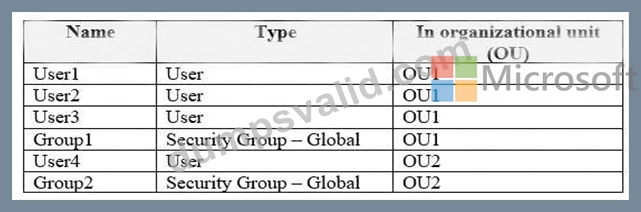
The groups have the memberships shown in the following table.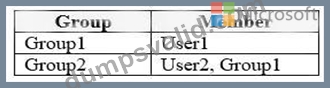
OU1 and OU2 are synced to Azure Active Directory (Azure AD).
You modify the synchronization settings and remove OU1 from synchronization. You sync Active Directory and Azure AD.
Which objects are in Azure AD?
- A. User1, User2, User3, User4, Group1, and Group2
- B. User4 and Group2 only
- C. User2, Group1, User4, and Group2 only
- D. User1, User2, Group1, User4, and Group2 only
Answer: D
NEW QUESTION 40
You have an Azure subscription that contains the resources in the following table.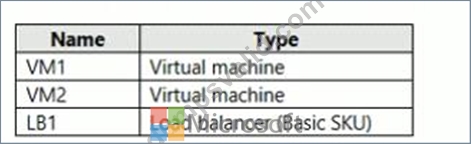
You install the Web Server server role (IIS) on VM1 and VM2, and then and VM1 and VM2 to LB1.
LB1 is configured as shown in the LB1 exhibit. (Click the LB1 tab.)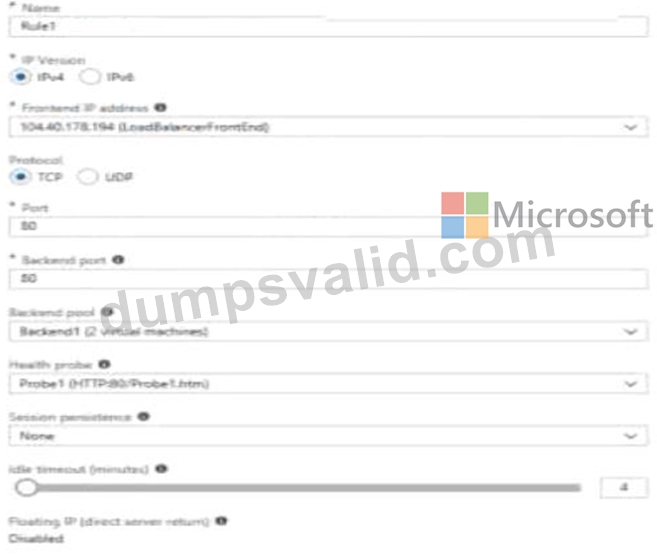
Rule1 is configure as shown in the Rule1 exhibit. (Click the Rule tab.) For each of the following statements, select Yes if the statements is true. Otherwise, select No.
NOTE: Each correct selection is worth one point.
Answer:
Explanation: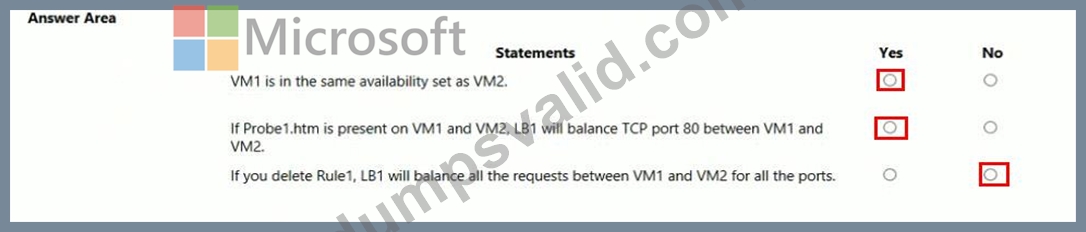
Reference:
https://docs.microsoft.com/en-us/azure/load-balancer/skus
https://docs.microsoft.com/en-us/azure/load-balancer/load-balancer-custom-probe-overview
NEW QUESTION 41
You have Azure virtual machines that run Windows Server 2019 and are configured as shown in the following table.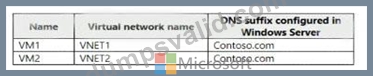
You create a public Azure DNS zone named adatum.com and a private Azure DNS zone named contoso.com.
For contoso.com, you create a virtual network link named link1 as shown in the exhibit. (Click the Exhibit tab.)
You discover that VM1 can resolve names in contoso.com but cannot resolve names in adatum.com. VM1 can resolve other hosts on the internet.
You need to ensure that VM1 can resolve host names in adatum.com.
What should you do?
- A. Configure the name servers for adatum.com at the domain registrar.
- B. Update the DNS suffix on VM1 to be adatum.com.
- C. Create an SRV record in the contoso.com zone.
- D. Modify the Access control (IAM) settings for link1.
Answer: A
Explanation:
Explanation
Adatum.com is a public DNS zone. The Internet top level domain DNS servers need to know which DNS servers to direct DNS queries for adatum.com to. You configure this by configuring the name servers for adatum.com at the domain registrar.
Reference:
https://docs.microsoft.com/en-us/azure/dns/dns-getstarted-portal
NEW QUESTION 42
You have an Azure subscription that contains the resources shown in the following table.
All virtual machines run Windows Server 2016.
On VM1, you back up a folder named Folder1 as shown in the following exhibit.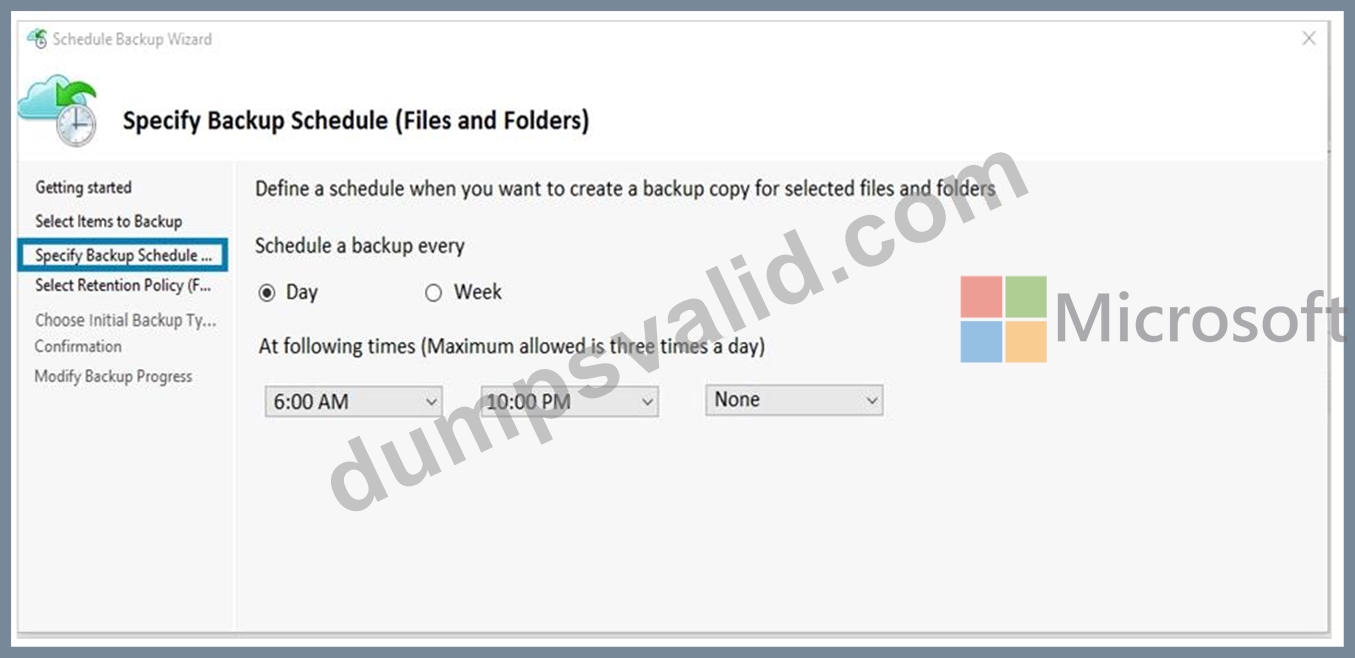
You plan to restore the backup to a different virtual machine.
You need to restore the backup to VM2.
What should you do first?
- A. From VM2, install the Windows Server Backup feature
- B. From VM2, install the Microsoft Azure Recovery Services Agent
- C. From VM1, install the Windows Server Backup feature
- D. From VM1, install the Microsoft Azure Recovery Services Agent
Answer: B
Explanation:
Reference:
https://docs.microsoft.com/en-us/azure/backup/backup-azure-restore-windows-server
NEW QUESTION 43
You have an Azure Service Bus.
You create a queue named Queue1. Queue1 is configured as shown in the following exhibit.
Use the drop-down menus to select the answer choice that completes each statement based on the information presented in the graphic.
NOTE:Each correct selection is worth one point.
Answer:
Explanation:
Explanation
Box 1: retained until manually deleted
Since by default PeekLock shall be enabled in Queue, so it will move to DeadLetter after 2hours and stays there until manually deleted. Messages in the dead letter queue should be deleted manually.
Box 2: deleted immediately
Once a message is pulled, it will be deleted immediately. It does not make sense to keep the message further 5 minutes "locked" in the queue. Locking the message makes sense, for the case, when processing the message from a receiver, to lock the message, to avoid processing/receiving the message simultaneously by another receiver.
The receiving client initiates settlement of a received message with a positive acknowledgment when it calls Complete at the API level. This indicates to the broker that the message has been successfully processed and the message is removed from the queue or subscription.
Reference:
https://docs.microsoft.com/en-us/azure/service-bus-messaging/message-expiration
https://docs.microsoft.com/en-us/azure/service-bus-messaging/message-transfers-locks-settlement
NEW QUESTION 44
SIMULATION
Overview
The following section of the exam is a lab. In this section, you will perform a set of tasks in a live environment. While most functionality will be available to you as it would be in a live environment, some functionality (e.g., copy and paste, ability to navigate to external websites) will not be possible by design.
Scoring is based on the outcome of performing the tasks stated in the lab. In other words, it doesn't matter how you accomplish the task, if you successfully perform it, you will earn credit for that task.
Labs are not timed separately, and this exam may have more than one lab that you must complete. You can use as much time as you would like to complete each lab. But, you should manage your time appropriately to ensure that you are able to complete the lab(s) and all other sections of the exam in the time provided.
Please note that once you submit your work by clicking the Next button within a lab, you will NOT be able to return to the lab.
To start the lab
You may start the lab by clicking the Next button.
You plan to allow connections between the VNET01-USEA2 and VNET01-USWE2 virtual networks.
You need to ensure that virtual machines can communicate across both virtual networks by using their private IP address. The solution must NOT require any virtual network gateways.
What should you do from the Azure portal?
- A. See below explanation
Answer: A
Explanation:
Virtual network peering enables you to seamlessly connect two Azure virtual networks. Once peered, the virtual networks appear as one, for connectivity purposes.
Peer virtual networks
Step 1. In the Search box at the top of the Azure portal, begin typing VNET01-USEA2. When VNET01- USEA2 appears in the search results, select it.
Step 2. Select Peerings, under SETTINGS, and then select + Add, as shown in the following picture: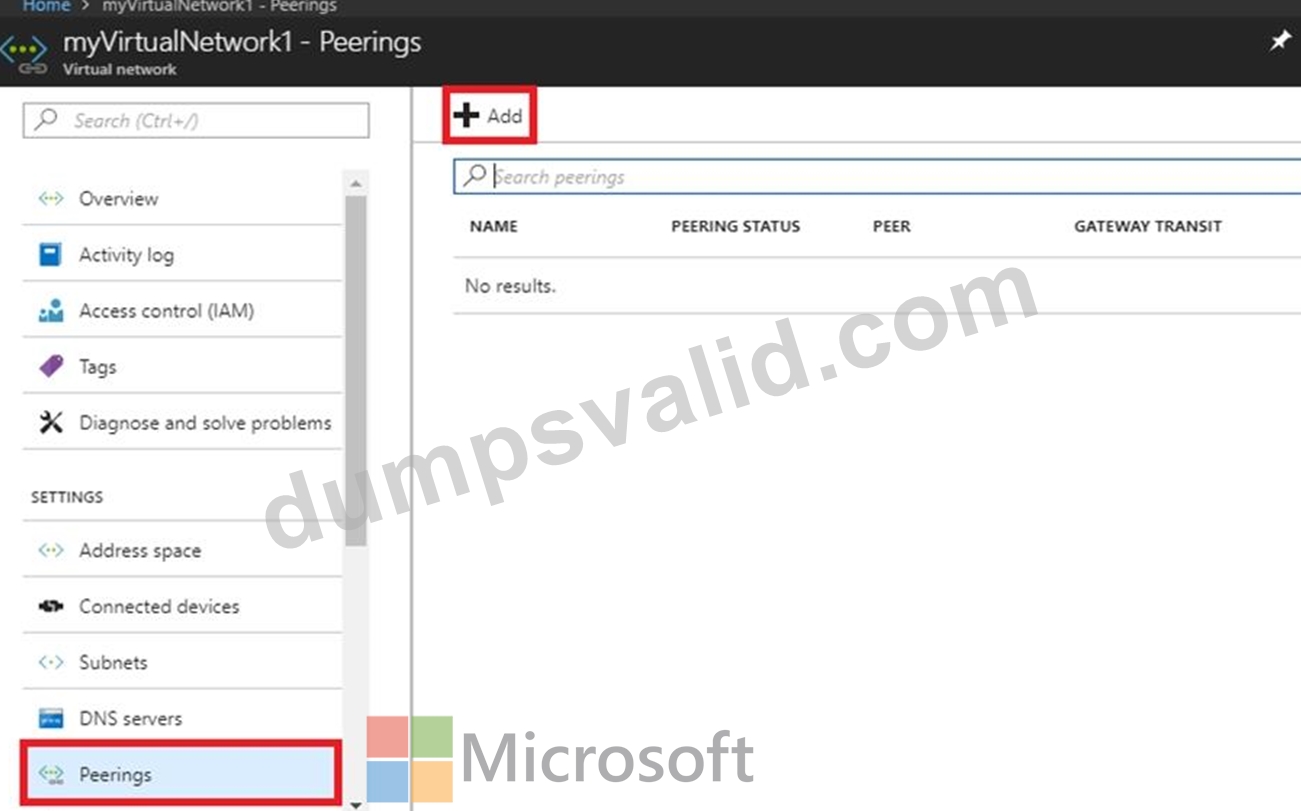
Step 3. Enter, or select, the following information, accept the defaults for the remaining settings, and then select OK.
Name: myVirtualNetwork1-myVirtualNetwork2 (for example)
Subscription: elect your subscription.
Virtual network: VNET01-USWE2 - To select the VNET01-USWE2 virtual network, select Virtual network, then select VNET01-USWE2. You can select a virtual network in the same region or in a different region.
Now we need to repeat steps 1-3 for the other network VNET01-USWE2:
Step 4. In the Search box at the top of the Azure portal, begin typing VNET01- USEA2. When VNET01- USEA2 appears in the search results, select it.
Step 5. Select Peerings, under SETTINGS, and then select + Add.
References:
https://docs.microsoft.com/en-us/azure/virtual-network/tutorial-connect-virtual-networks-portal
NEW QUESTION 45
You have an Azure subscription that contains the following users in an Azure Active Directory tenant named contoso.onmicrosoft.com:
User1 creates a new Azure Active Directory tenant named external.contoso.onmicrosoft.com.
You need to create new user accounts in external.contoso.com.onmicrosoft.com.
Solution: You instruct User2 to create the user accounts.
- A. No
- B. Yes
Answer: B
Explanation:
Explanation
Only a global administrator can add users to this tenant.
References:
https://docs.microsoft.com/en-us/azure/devops/organizations/accounts/add-users-to-azure-ad
NEW QUESTION 46
You need to create an Azure Storage account that meets the following requirements:
* Minimizes costs
* Supports hot, cool, and archive blob tiers
* Provides fault tolerance if a disaster affects the Azure region where the account resides How should you complete the command? To answer, select the appropriate options in the answer are a. NOTE: Each correct selection is worth one point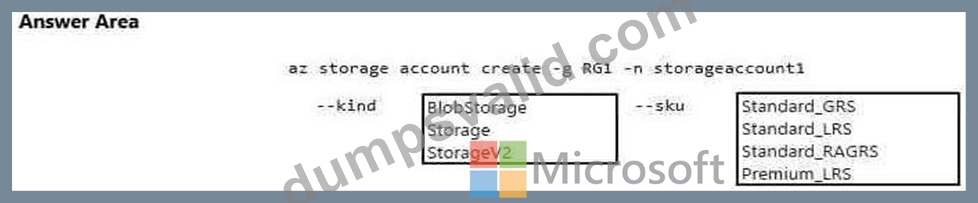
Answer:
Explanation: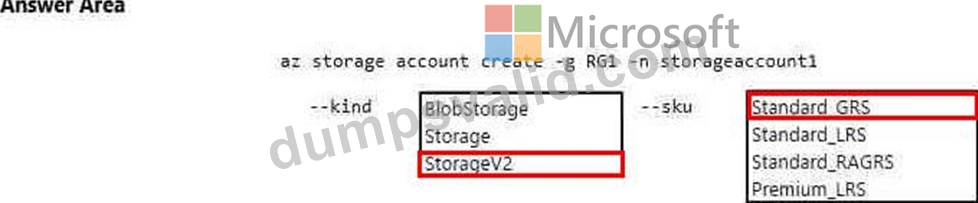
Explanation:
Box 1: StorageV2
You may only tier your object storage data to hot, cool, or archive in Blob storage and General Purpose v2 (GPv2) accounts. General Purpose v1 (GPv1) accounts do not support tiering.
General-purpose v2 accounts deliver the lowest per-gigabyte capacity prices for Azure Storage, as well as industry-competitive transaction prices.
Box 2: Standard_GRS
Geo-redundant storage (GRS): Cross-regional replication to protect against region-wide unavailability.
Incorrect Answers:
Locally-redundant storage (LRS): A simple, low-cost replication strategy. Data is replicated within a single storage scale unit.
Read-access geo-redundant storage (RA-GRS): Cross-regional replication with read access to the replica. RA-GRS provides read-only access to the data in the secondary location, in addition to geo-replication across two regions, but is more expensive compared to GRS.
References:
https://docs.microsoft.com/en-us/azure/storage/common/storage-redundancy-grs
https://docs.microsoft.com/en-us/azure/storage/blobs/storage-blob-storage-tiers
NEW QUESTION 47
You need to use Azure Automation State Configuration to manage the ongoing consistency of virtual machine configurations.
Which five actions should you perform in sequence? To answer, move the appropriate action from the list of actions to the answer area and arrange them in the correct order.
NOTE: More than one order of answer choices is correct. You will receive credit for any of the correct orders you select.
Answer:
Explanation: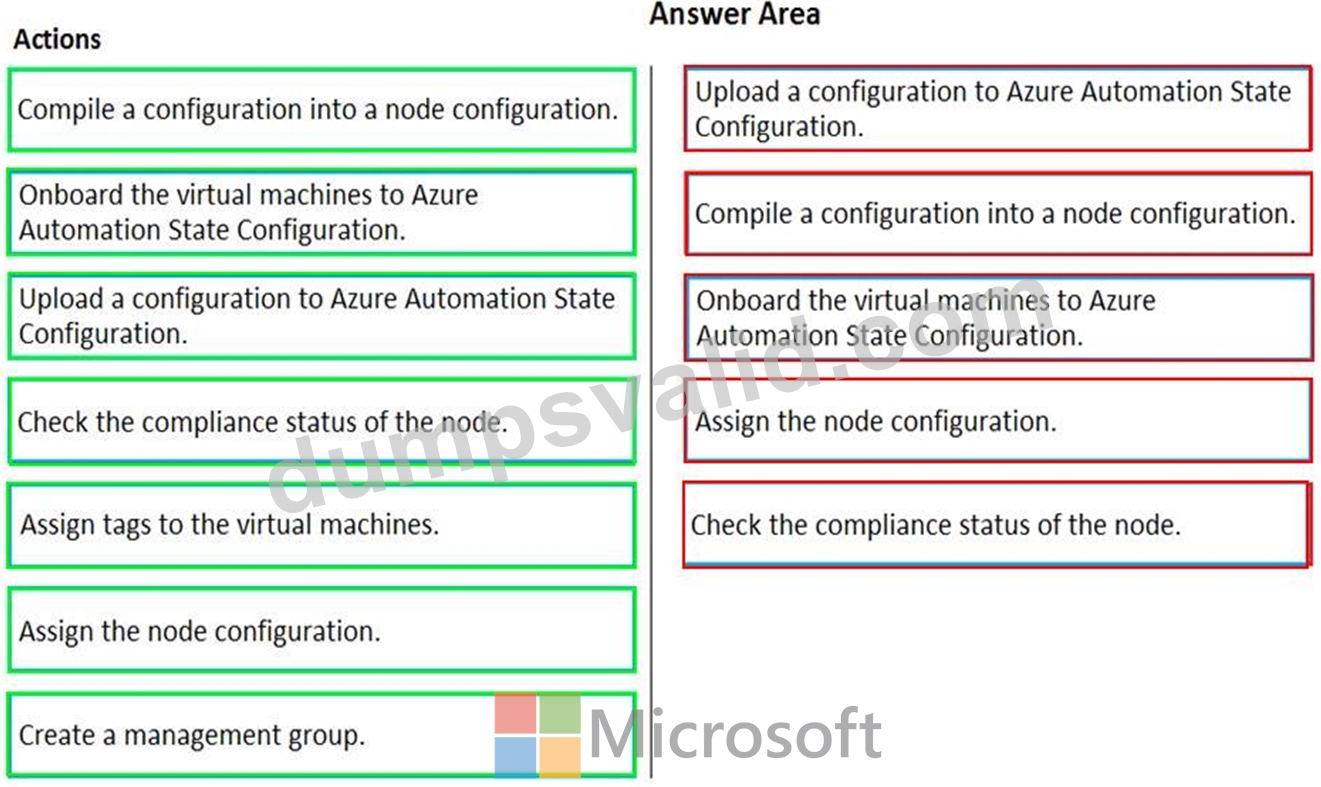
Explanation:
Step 1: Upload a configuration to Azure Automation State Configuration.
Import the configuration into the Automation account.
Step 2: Compile a configuration into a node configuration.
A DSC configuration defining that state must be compiled into one or more node configurations (MOF document), and placed on the Automation DSC Pull Server.
Step 3: Onboard the virtual machines to Azure Automation State Configuration.
Onboard the Azure VM for management with Azure Automation State Configuration
Step 4: Assign the node configuration
Step 5: Check the compliance status of the node
Each time Azure Automation State Configuration performs a consistency check on a managed node, the node sends a status report back to the pull server. You can view these reports on the page for that node.
On the blade for an individual report, you can see the following status information for the corresponding consistency check:
The report status - whether the node is "Compliant", the configuration "Failed", or the node is "Not Compliant"
References:
https://docs.microsoft.com/en-us/azure/automation/automation-dsc-getting-started
NEW QUESTION 48
You have an Azure subscription that contains an Azure Directory (Azure AD) tenant named contoso.com. The tenant is synced to the on-premises Active Directory domain. The domain contains the users shown in the following table.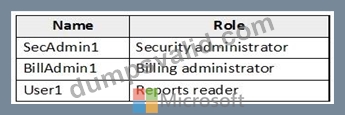
You enable self-service password reset (SSPR) for all users and configure SSPR to have the following authentication methods:
Number of methods required to reset: 2
Methods available to users: Mobile phone, Security questions
Number of questions required to register: 3
Number of questions required to reset: 3
You select the following security questions:
What is your favorite food?
In what city was your first job?
What was the name of your first pet?
For each of the following statements, select Yes if the statement is true. Otherwise, select No.
NOTE: Each correct selection is worth one point.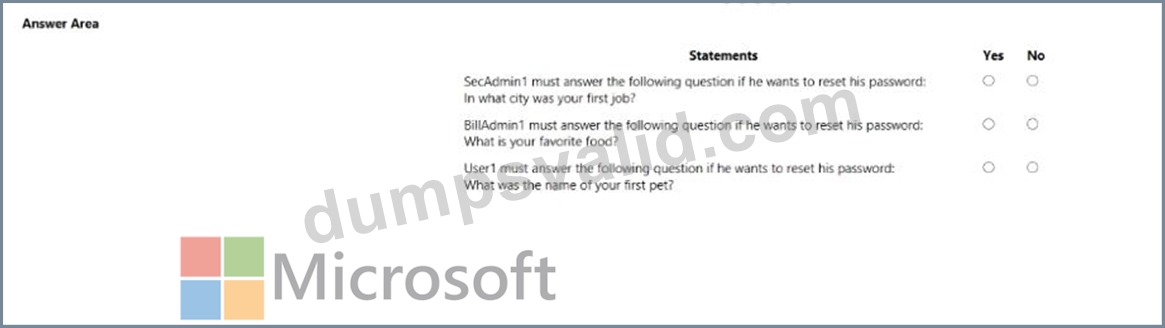
Answer:
Explanation:
References:
https://docs.microsoft.com/en-us/azure/active-directory/authentication/howto-sspr-deployment
NEW QUESTION 49
You are configuring serverless computing in Azure.
You need to receive an email message whenever a resource is created in or deleted from a resource group. Which three actions should you perform in sequence? To answer, move the appropriate actions from the list of actions to the answer area and arrange them in the correct order.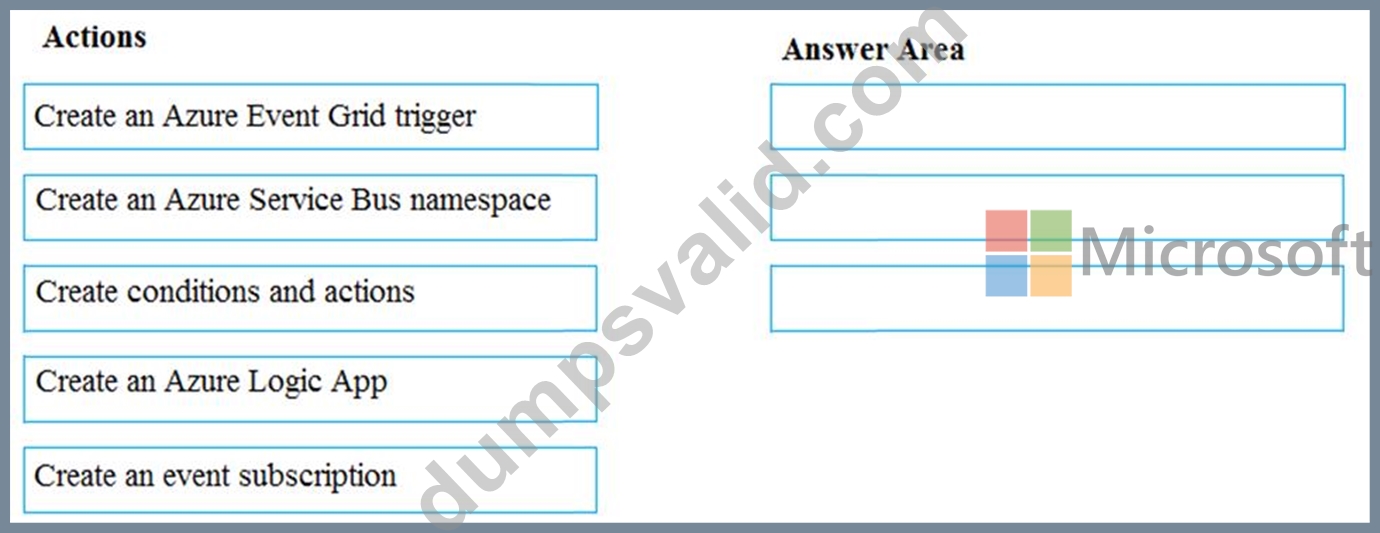
Answer:
Explanation: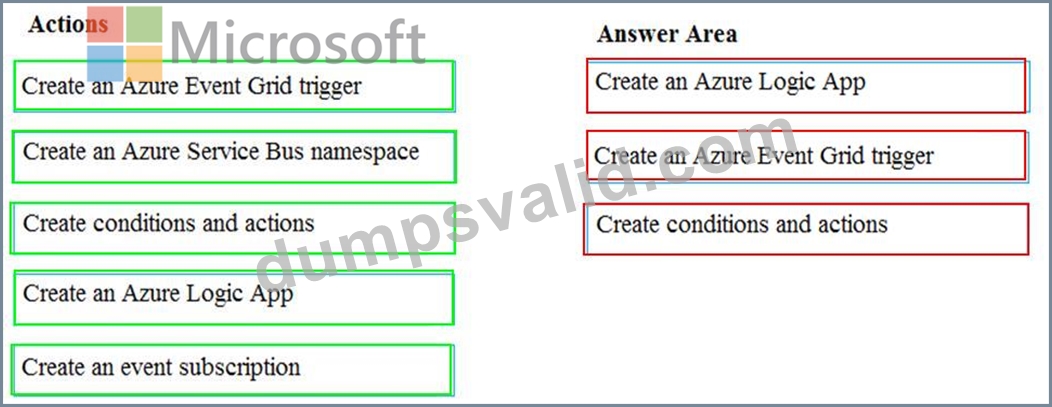
References:
https://docs.microsoft.com/en-us/azure/event-grid/monitor-virtual-machine-changes-event-grid-logic-app
NEW QUESTION 50
You have an Azure subscription named Subscription1.
In Subscription1, you create an Azure file share named share1.
You create a shared access signature (SAS) named SAS1 as shown in the following exhibit.
To answer, select the appropriate options in the answer area.
NOTE: Each correct selection is worth one point.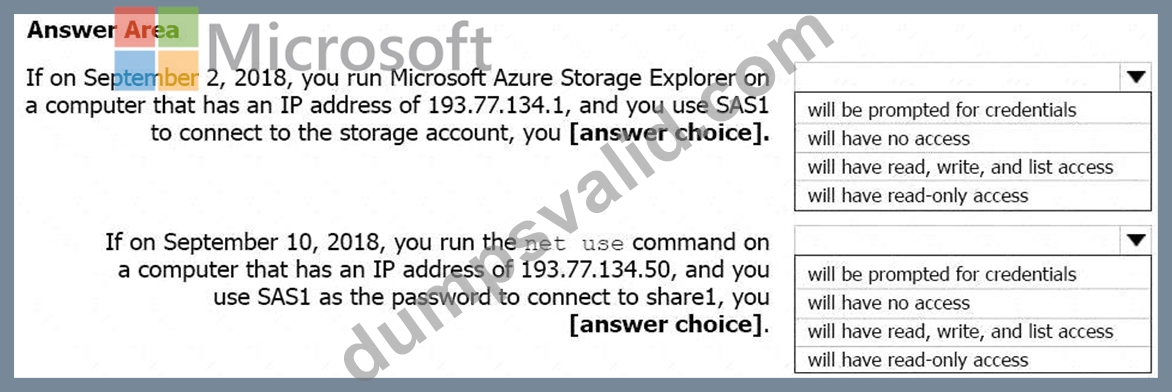
Answer:
Explanation:
Explanation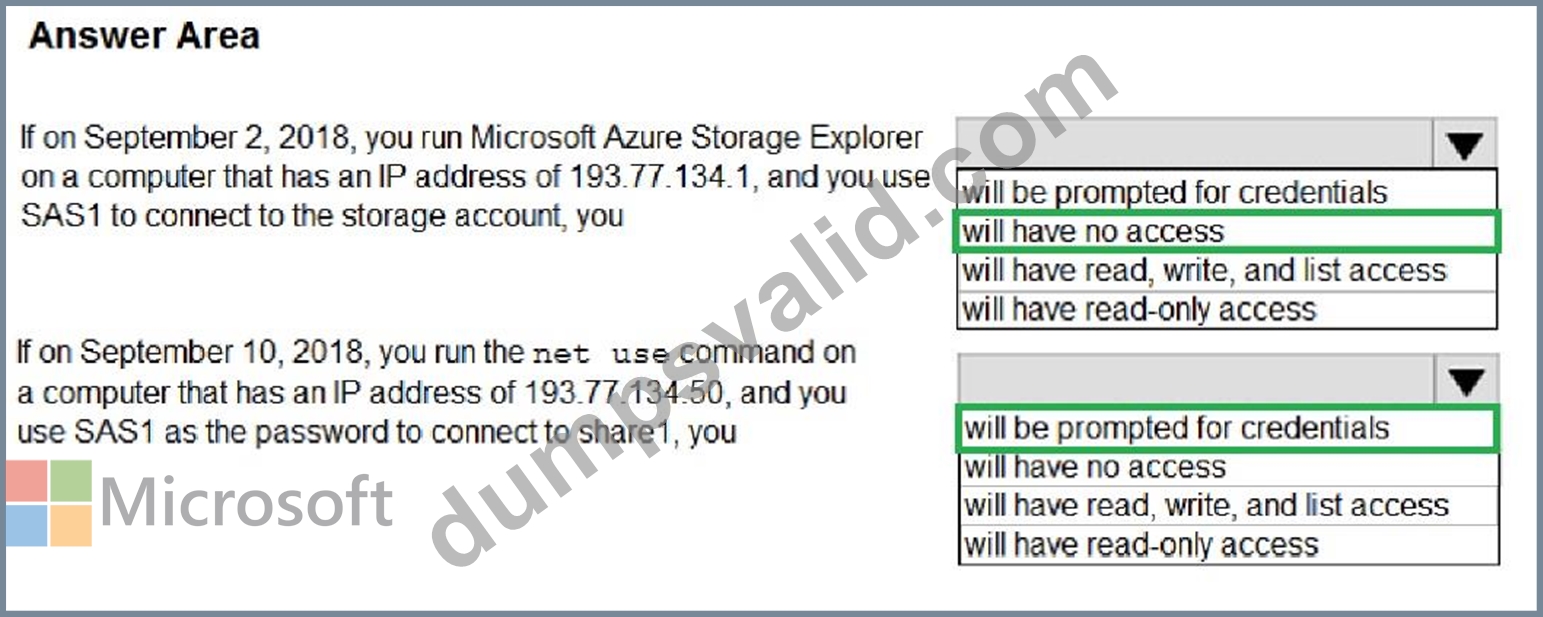
Box 1: will have no access
The IP 193.77.134.1 does not have access on the SAS since this IP falls outside of the allowed IP address range for SAS. Hence "will have no access" is correct.
Box 2: will be prompted for credentials
The net use command is used to connect to file shares.To mount an Azure file share, you will need the primary (or secondary) storage key. SAS keys are not currently supported for mounting. Based on the provided SAS exhibit, IP address is an allowed IP and also on given date SAS is active, but account storage key is must to have to run the "net use" command , which is not provided in the question. Hence "will be prompted for credentials" is correct option for this.
net use R: \rebelsa1.file.core.windows.net\rebelshare <storage key> /user:Azure\rebelsa1 References:
https://docs.microsoft.com/en-us/azure/vs-azure-tools-storage-manage-with-storage-explorer?tabs=windows
https://feedback.azure.com/forums/217298-storage/suggestions/14498352-allow-azure-files-shares-to-be-mounte
https://docs.microsoft.com/en-us/azure/storage/common/storage-sas-overview
https://docs.microsoft.com/en-us/azure/storage/files/storage-how-to-use-files-windows
http://www.rebeladmin.com/2018/03/step-step-guide-create-azure-file-share-map-windows-10/
NEW QUESTION 51
You have an Azure Active Directory (Azure AD) tenant named contoso.onmicrosoft.com.
You hire a temporary vendor. The vendor uses a Microsoft account that has a sign-in of [email protected].
You need to ensure that the vendor can authenticate to the tenant by using [email protected].
What should you do?
- A. From Windows PowerShell, run the New-AzureADUser cmdlet and specify the -UserPrincipalName [email protected] parameter.
- B. From the Azure portal, add a new guest user, and then specify [email protected] as the email address.
- C. From Azure Cloud Shell, run the New-AzureADUser cmdlet and specify the -UserPrincipalName [email protected] parameter.
- D. From the Azure portal, add a custom domain name, create a new Azure AD user, and then specify [email protected] as the username.
Answer: B
Explanation:
Explanation
UserPrincipalName - contains the UserPrincipalName (UPN) of this user. The UPN is what the user will use when they sign in into Azure AD. The common structure is @, so for Abby Brown in Contoso.com, the UPN would be [email protected] Example:
To create the user, call the New-AzureADUser cmdlet with the parameter values:
powershell New-AzureADUser -AccountEnabled $True -DisplayName "Abby Brown"
-PasswordProfile$PasswordProfile -MailNickName "AbbyB" -UserPrincipalName "[email protected]" References:
https://docs.microsoft.com/bs-cyrl-ba/powershell/azure/active-directory/new-user-sample?view=azureadps-2.0
NEW QUESTION 52
You have an app named App1 that runs on two Azure virtual machines named VM1 and VM2.
You plan to implement an Azure Availability Set for App1. The solution must ensure that App1 is available during planned maintenance of the hardware hosting VM1 and VM2.
What should you include in the Availability Set?
- A. one fault domain
- B. one update domain
- C. two update domains
- D. two fault domains
Answer: C
Explanation:
Microsoft updates, which Microsoft refers to as planned maintenance events, sometimes require that VMs be rebooted to complete the update. To reduce the impact on VMs, the Azure fabric is divided into update domains to ensure that not all VMs are rebooted at the same time.
Incorrect Answers:
A: An update domain is a group of VMs and underlying physical hardware that can be rebooted at the same time.
B, C: A fault domain shares common storage as well as a common power source and network switch. It is used to protect against unplanned system failure.
References:
https://petri.com/understanding-azure-availability-sets
https://docs.microsoft.com/en-us/azure/virtual-machines/windows/tutorial-availability-sets
NEW QUESTION 53
You have an Azure subscription.
You activate Enterprise Mobility + Security E5 licenses for all users.
You need the users to request approval before they can create virtual machines.
What should you configure first?
- A. Azure Active Directory (Azure AD) Privileged Identity Management for the Azure AD directory roles Explanation
- B. Azure Active Directory (Azure AD) Privileged Identity Management for the Azure resource roles
- C. Azure Active Directory (Azure AD) Authentication methods
- D. Azure Active Directory (Azure AD) conditional access policies
Answer: B
Explanation:
https://docs.microsoft.com/en-us/azure/active-directory/privileged-identity-management/pim-resource-roles-assign-roles
NEW QUESTION 54
Your company has offices in New York and Los Angeles.
You have an Azure subscription that contains an Azure virtual network named VNet1. Each office has a site-to-site VPN connection to VNet1.
Each network uses the address spaces shown in the following table.
You need to ensure that all Internet-bound traffic from VNet1 is routed through the New York office.
What should you do? To answer, select the appropriate options in the answer area.
NOTE: Each correct selection is worth one point.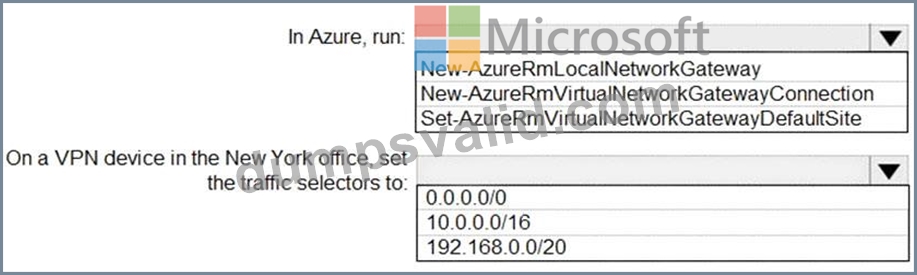
Answer:
Explanation:
Explanation
Box 1 : Set-AzureRmVirtualNetworkGatewayDefaultSite
The Set-AzureRmVirtualNetworkGatewayDefaultSite cmdlet assigns a forced tunneling default site to a virtual network gateway. Forced tunneling provides a way for you to redirect Internet-bound traffic from Azure virtual machines to your on-premises network; this enables you to inspect and audit traffic before releasing it. Forced tunneling is carried out by using a virtual private network (VPN) tunnel; this tunnel requires a default site, a local gateway where all the Azure Internet-bound traffic is redirected. Set-AzureRmVirtualNetworkGatewayDefaultSite provides a way to change the default site assigned to a gateway.
Box 2 : 0.0.0.0/0
Forced tunneling must be associated with a VNet that has a route-based VPN gateway. You need to set a
"default site" among the cross-premises local sites connected to the virtual network. Also, the on-premises VPN device must be configured using 0.0.0.0/0 as traffic selectors.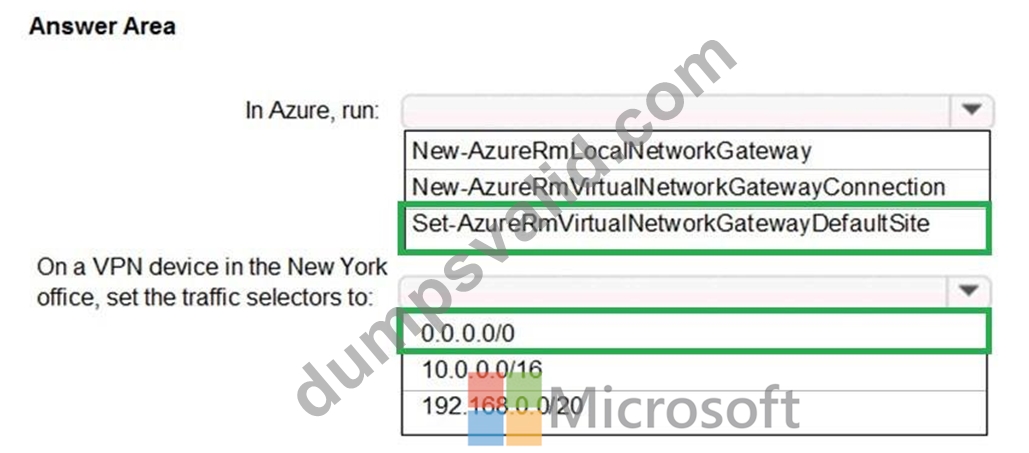
Forced Tunneling:
The following diagram illustrates how forced tunneling works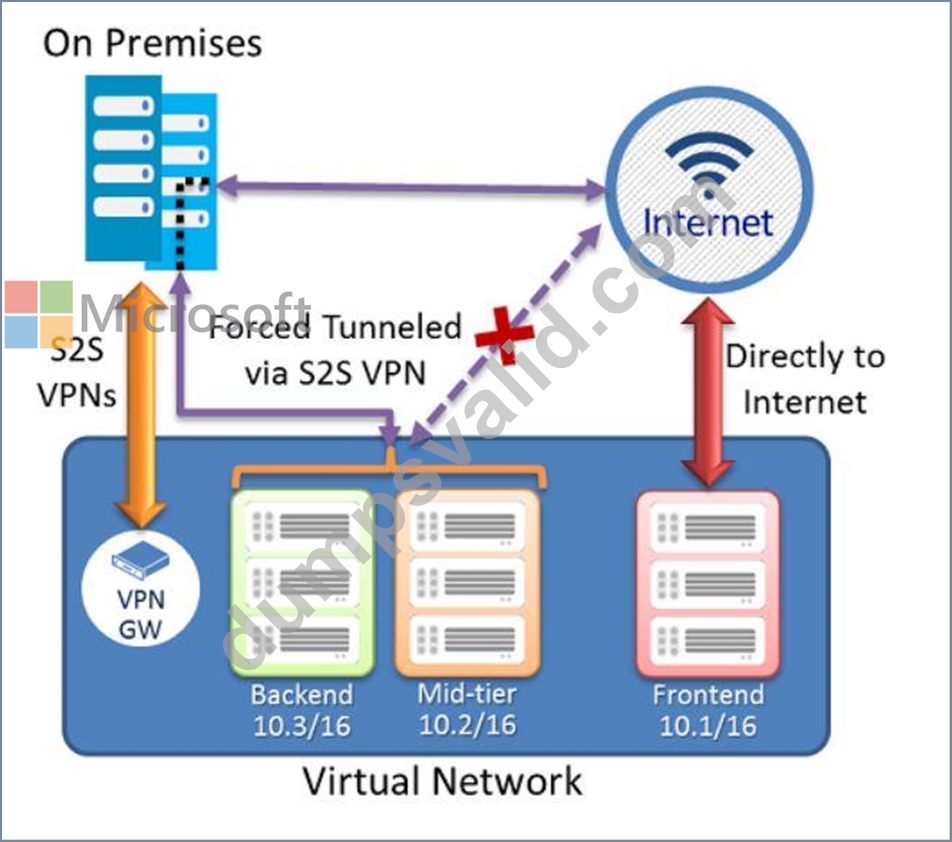
Reference:
https://docs.microsoft.com/en-us/powershell/module/azurerm.network/set-azurermvirtualnetworkgatewaydefault
https://docs.microsoft.com/en-us/azure/vpn-gateway/vpn-gateway-forced-tunneling-rm
NEW QUESTION 55
You have an Azure subscription named Sub1.
You plan to deploy a multi-tiered application that will contain the tiers shown in the following table.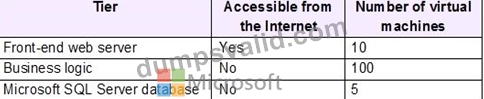
You need to recommend a networking solution to meet the following requirements:
* Ensure that communication between the web servers and the business logic tier spreads equally across the virtual machines.
* Protect the web servers from SQL injection attacks.
Which Azure resource should you recommend for each requirement? To answer, select the appropriate options in the answer area.
NOTE: Each correct selection is worth one point.
Answer:
Explanation: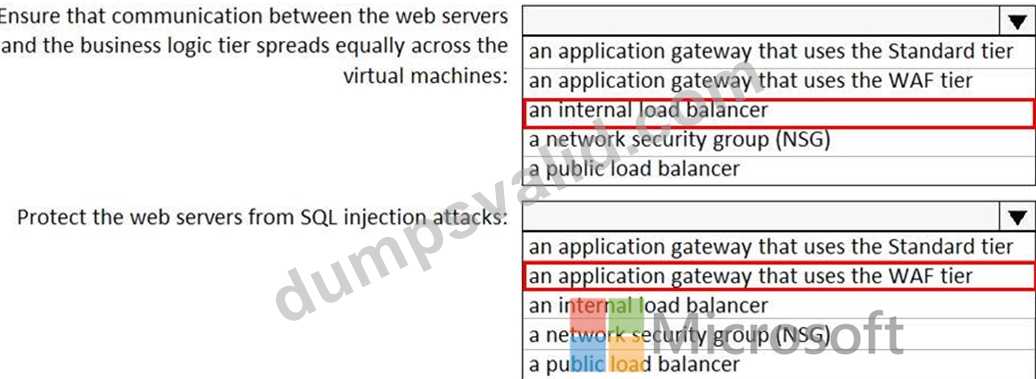
Explanation:
Box 1: an internal load balancer
Azure Internal Load Balancer (ILB) provides network load balancing between virtual machines that reside inside a cloud service or a virtual network with a regional scope.
Box 2: an application gateway that uses the WAF tier
Azure Web Application Firewall (WAF) on Azure Application Gateway provides centralized protection of your web applications from common exploits and vulnerabilities. Web applications are increasingly targeted by malicious attacks that exploit commonly known vulnerabilities.
References:
https://docs.microsoft.com/en-us/azure/web-application-firewall/ag/ag-overview
NEW QUESTION 56
You have the Azure virtual machines shown in the following table.
A DNS service is install on VM1.
You configure the DNS server settings for each virtual network as shown in the following exhibit.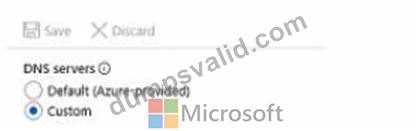
You need 10 ensure that all the virtual machines can resolve DNS names by using the DNS service on VM1.
What should you do?
- A. Add service endpoints on VNET2 and VNET3.
- B. Add service endpoints on VNET1.
- C. Configure peering between VNE11, VNETT2, and VNET3.
- D. Configure a conditional forwarder on VM1
Answer: C
Explanation:
Explanation
An Azure AD DS DNS zone should only contain the zone and records for the managed domain itself.
A conditional forwarder is a configuration option in a DNS server that lets you define a DNS domain, such as contoso.com, to forward queries to. Instead of the local DNS server trying to resolve queries for records in that domain, DNS queries are forwarded to the configured DNS for that domain. This configuration makes sure that the correct DNS records are returned, as you don't create a local a DNS zone with duplicate records in the managed domain to reflect those resources.
To create a conditional forwarder in your managed domain, complete the following steps:
1. Select your DNS zone, such as aaddscontoso.com.
2. Select Conditional Forwarders, then right-select and choose New Conditional Forwarder...
3. Enter your other DNS Domain, such as contoso.com, then enter the IP addresses of the DNS servers for that namespace, as shown in the following example: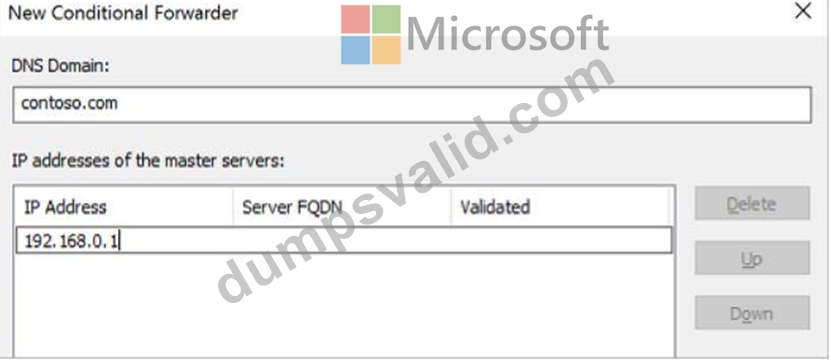
4. Check the box for Store this conditional forwarder in Active Directory, and replicate it as follows, then select the option for All DNS servers in this domain, as shown in the following example: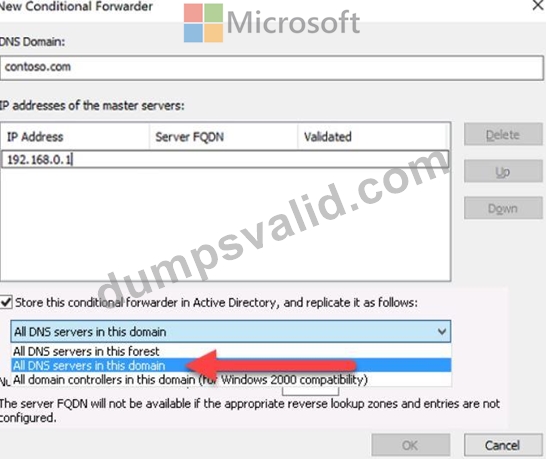
5. To create the conditional forwarder, select OK.
Name resolution of the resources in other namespaces from VMs connected to the managed domain should now resolve correctly. Queries for the DNS domain configured in the conditional forwarder are passed to the relevant DNS servers.
Reference:
https://docs.microsoft.com/en-us/azure/virtual-network/virtual-networks-name-resolution-for-vms-and-role-insta
https://docs.microsoft.com/en-us/azure/active-directory-domain-services/manage-dns
NEW QUESTION 57
You have an Azure subscription
You need to use an Azure Resource Manager (ARM) template to create a virtual machine that will have multiple data disks.
How should you complete the template? To answer select the appropriate options in the answer area NOTE: Each correct selection n worth one point.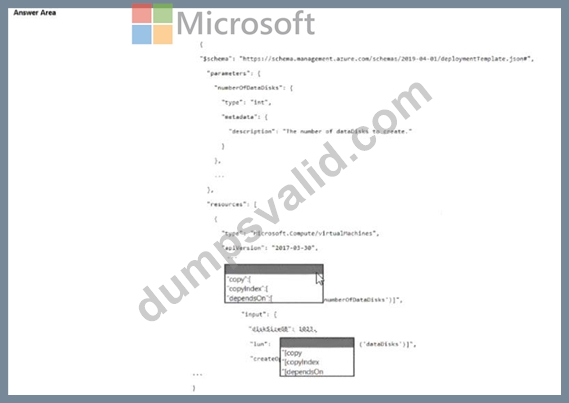
Answer:
Explanation:
Explanation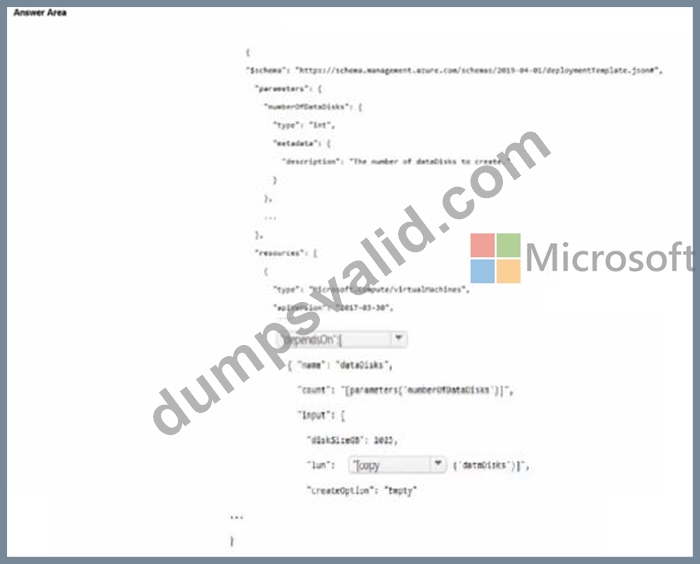
NEW QUESTION 58
You have the Azure virtual machines shown in the following table.
You have a Recovery Services vault that protects VM1 and VM2.
You need to protect VM3 and VM4 by using Recovery Services.
What should you do first?
- A. Create a new Recovery Services vault.
- B. Create a new backup policy.
- C. Create a storage account.
- D. Configure the extensions for VM3 and VM4.
Answer: A
Explanation:
Explanation
A Recovery Services vault is a storage entity in Azure that houses data. The data is typically copies of data, or configuration information for virtual machines (VMs), workloads, servers, or workstations. You can use Recovery Services vaults to hold backup data for various Azure services References: https://docs.microsoft.com/en-us/azure/site-recovery/azure-to-azure-tutorial-enable-replication
NEW QUESTION 59
......
Prerequisites
Before going for the Microsoft AZ-104 exam, you should have a minimum of six months of practical experience in administering Azure. Additionally, you should possess an in-depth understanding of Azure workloads, core Azure services, governance, and security. The applicants also need to have experience with PowerShell, Azure Resource Manager templates, Azure portal, and Azure CLI. The candidates for the test are the Microsoft Azure Administrators who have the ability to complete the technical tasks highlighted in the domains of the exam objectives.
AZ-104:Microsoft Azure Administrator Exam Certified Professional salary
The average salary of an AZ-104: Microsoft Azure Administrator Exam Certified Expert in
- United States - 80,000 USD
- Europe - 60,547 EURO
- India - 12,10,327 INR
- England - 60,532 POUNDS
Latest AZ-104 Pass Guaranteed Exam Dumps Certification Sample Questions: https://testprep.dumpsvalid.com/AZ-104-brain-dumps.html