

 PDF Version Demo
It is an admitted fact that certification is of great significance for workers to get better jobs as well as higher income, nevertheless, the exam serves as an obstacle without valid Databricks-Certified-Data-Engineer-Professional latest training material, in the way for workers to get the essential certification. Now, our company is here to provide a remedy--Databricks-Certified-Data-Engineer-Professional exam study material for you. Our company has gathered a large number of first-class experts who come from many different countries to work on compiling the Databricks-Certified-Data-Engineer-Professional exam topics pdf for the complicated exam. It goes without saying that such an achievement created by so many geniuses can make a hit in the international market. Here I would like to show more detailed information about our Databricks Databricks-Certified-Data-Engineer-Professional exam study material for you.

Fast delivery after payment
A person's life will encounter a lot of opportunity, but opportunity only favors the prepared mind (Databricks-Certified-Data-Engineer-Professional exam training questions), there is no denying fact that time is a crucial part in the course of preparing for exam. Our company has taken this into account at the very beginning, so that we have carried out the operation system to automatically send our Databricks Databricks-Certified-Data-Engineer-Professional latest training material to the email address that registered by our customers, which only takes 5 to 10 minutes in the whole process. That is to say, you can download Databricks-Certified-Data-Engineer-Professional exam study material and start to prepare for the exam only a few minutes after payment.
After purchase, Instant Download Databricks-Certified-Data-Engineer-Professional Dumps: Upon successful payment, Our systems will automatically send the product you have purchased to your mailbox by email. (If not received within 12 hours, please contact us. Note: don't forget to check your spam.)
Free demo before buying
Just like the old saying goes "something attempted, something done." Our Databricks-Certified-Data-Engineer-Professional exam study material has been well received by all of our customers in many different countries, which is definitely worth trying. The contents in our Databricks-Certified-Data-Engineer-Professional exam study material is the key points for the exam test, and the contents in the free demo is a part of our Databricks Databricks-Certified-Data-Engineer-Professional exam training questions, as is known to all, the essence lies in things condensed and reduced in size, therefore, you are provided the a chance to feel the essence of our Databricks-Certified-Data-Engineer-Professional valid exam guide. What's more, the question types are also the latest in the study material, so that with the help of our Databricks-Certified-Data-Engineer-Professional exam training questions, there is no doubt that you will pass the exam as well as get the certification without a hitch.
Build commitment through choice
Being for the purpose of catering to the various demands of our customers about Databricks-Certified-Data-Engineer-Professional exam study material, we provide three kinds of versions for our customers to choose namely, PDF version, PC test engine and APP test engine. Needless to say, the PDF version is convenient for you to read as well as printing, therefore you can concentrate on the Databricks Databricks-Certified-Data-Engineer-Professional valid updated questions almost anywhere at any time. The shining point of the PC test engine is that you can take part in the mock examination in the internet as long as your computer is equipped with Windows operation system. As for APP test engine, the greatest strength is that you can download it almost to any electronic equipment, what's more, you can read our Databricks-Certified-Data-Engineer-Professional practice exam material even in offline mode so long as you open it in online mode at the very first time.
Databricks Databricks-Certified-Data-Engineer-Professional Exam Syllabus Topics:
| Section | Weight | Objectives |
|---|---|---|
| Data Processing | 28% | - Structured Streaming - Spark SQL - Data Transformation - ETL Pipelines |
| Monitoring and Troubleshooting | 16% | - Monitoring - Performance Optimization - Troubleshooting |
| Data Modeling and Storage | 20% | - File Formats - Storage Optimization - Data Modeling |
| Data Quality and Governance | 12% | - Data Lineage - Governance - Data Quality |
| Databricks Lakehouse Platform | 24% | - Unity Catalog - Delta Lake - Lakehouse Architecture - Data Management |
Databricks Certified Data Engineer Professional Sample Questions:
1. A security team wants to enforce data protection for a customer table containing customer PII data. To comply with local policies, sales team members should only see customers from their region, while non-admin users should have email addresses masked. Which implementation approach should be used when using Unity Catalog row filters and column masks?
A) Use table ACLs to restrict access using tags with GRANT SELECT ON table_name WITH TAG command, and rely on application-level filtering for sensitive data based on user region.
B) Create SQL UDFs for row filtering based on user region and column masking based on group membership, then apply them using ALTER TABLE SET ROW FILTER and ALTER COLUMN SET MASK commands.
C) Create a view with dynamic WHERE clauses for region filtering and use string replacement functions for email masking using ALTER COLUMN SET MASK command.
D) Implement row filters with SQL UDFs based on user region only since column masks cannot be combined with row filters on the same table, then apply them be recreating the table with DROP TABLE and CREATE TABLE SET ROW FILTER commands.
2. A junior data engineer has configured a workload that posts the following JSON to the Databricks REST API endpoint 2.0/jobs/create.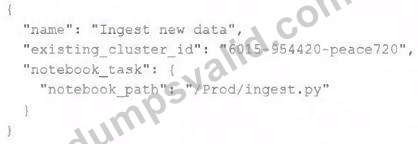
Assuming that all configurations and referenced resources are available, which statement describes the result of executing this workload three times?
A) Three new jobs named "Ingest new data" will be defined in the workspace, and they will each run once daily.
B) One new job named "Ingest new data" will be defined in the workspace, but it will not be executed.
C) The logic defined in the referenced notebook will be executed three times on new clusters with the configurations of the provided cluster ID.
D) Three new jobs named "Ingest new data" will be defined in the workspace, but no jobs will be executed.
E) The logic defined in the referenced notebook will be executed three times on the referenced existing all purpose cluster.
3. A data engineer, while designing a Pandas UDF to process financial time-series data with complex calculations that require maintaining state across rows within each stock symbol group, must ensure the function is efficient and scalable. Which approach will solve the problem with minimum overhead while preserving data integrity?
A) Use a SCALAR Pandas UDF that processes the entire dataset at once, implementing custom partitioning logic within the UDF to group by stock symbol and maintain state using global variables shared across all executor processes.
B) Use a grouped_agg Pandas UDF that processes each stock symbol group independently, maintaining state through intermediate aggregation results that get passed between successive UDF calls via broadcast variables.
C) Use a SCALAR_ITER Pandas UDF with iterator-based processing, implementing state management through persistent storage (Delta tables) that gets updated after each batch to maintain continuity across iterator chunks.
D) Use applyInPandas() on a Spark DataFrame that receives all rows for each stock symbol as a Pandas DataFrame, allowing processing within each group while maintaining state variables local to each group's processing function.
4. A Structured Streaming job deployed to production has been experiencing delays during peak hours of the day. At present, during normal execution, each microbatch of data is processed in less than 3 seconds. During peak hours of the day, execution time for each microbatch becomes very inconsistent, sometimes exceeding 30 seconds. The streaming write is currently configured with a trigger interval of 10 seconds.
Holding all other variables constant and assuming records need to be processed in less than 10 seconds, which adjustment will meet the requirement?
A) Increase the trigger interval to 30 seconds; setting the trigger interval near the maximum execution time observed for each batch is always best practice to ensure no records are dropped.
B) Decrease the trigger interval to 5 seconds; triggering batches more frequently may prevent records from backing up and large batches from causing spill.
C) The trigger interval cannot be modified without modifying the checkpoint directory; to maintain the current stream state, increase the number of shuffle partitions to maximize parallelism.
D) Use the trigger once option and configure a Databricks job to execute the query every 10 seconds; this ensures all backlogged records are processed with each batch.
E) Decrease the trigger interval to 5 seconds; triggering batches more frequently allows idle executors to begin processing the next batch while longer running tasks from previous batches finish.
5. Where in the Spark UI can one diagnose a performance problem induced by not leveraging predicate push-down?
A) In the Executor's log file, by gripping for "predicate push-down"
B) In the Storage Detail screen, by noting which RDDs are not stored on disk
C) In the Query Detail screen, by interpreting the Physical Plan
D) In the Delta Lake transaction log. by noting the column statistics
E) In the Stage's Detail screen, in the Completed Stages table, by noting the size of data read from the Input column
Solutions:
| Question # 1 Answer: B | Question # 2 Answer: D | Question # 3 Answer: D | Question # 4 Answer: B | Question # 5 Answer: C |


 Lawrence
 Malcolm
 Hilary
  Helen
Helen 
 Juliet
  Jack
Jack  Merlin
  Lionel
  Joyce
Joyce  John
John  Mona
Mona  Lynn
Lynn  Humphrey
  Don
Don  Meredith


